In mitl, in chimalli

Eagle and jaguar

Facts first. The chimalli is a real object: cane, hide, feathers, gold. Rank is in Codex Mendoza. The coyote in Vienna is still there. What is painted for this hall is labeled. What is the book or the museum is not.

Tlaneltoquiliztli

Facts

  1. 01

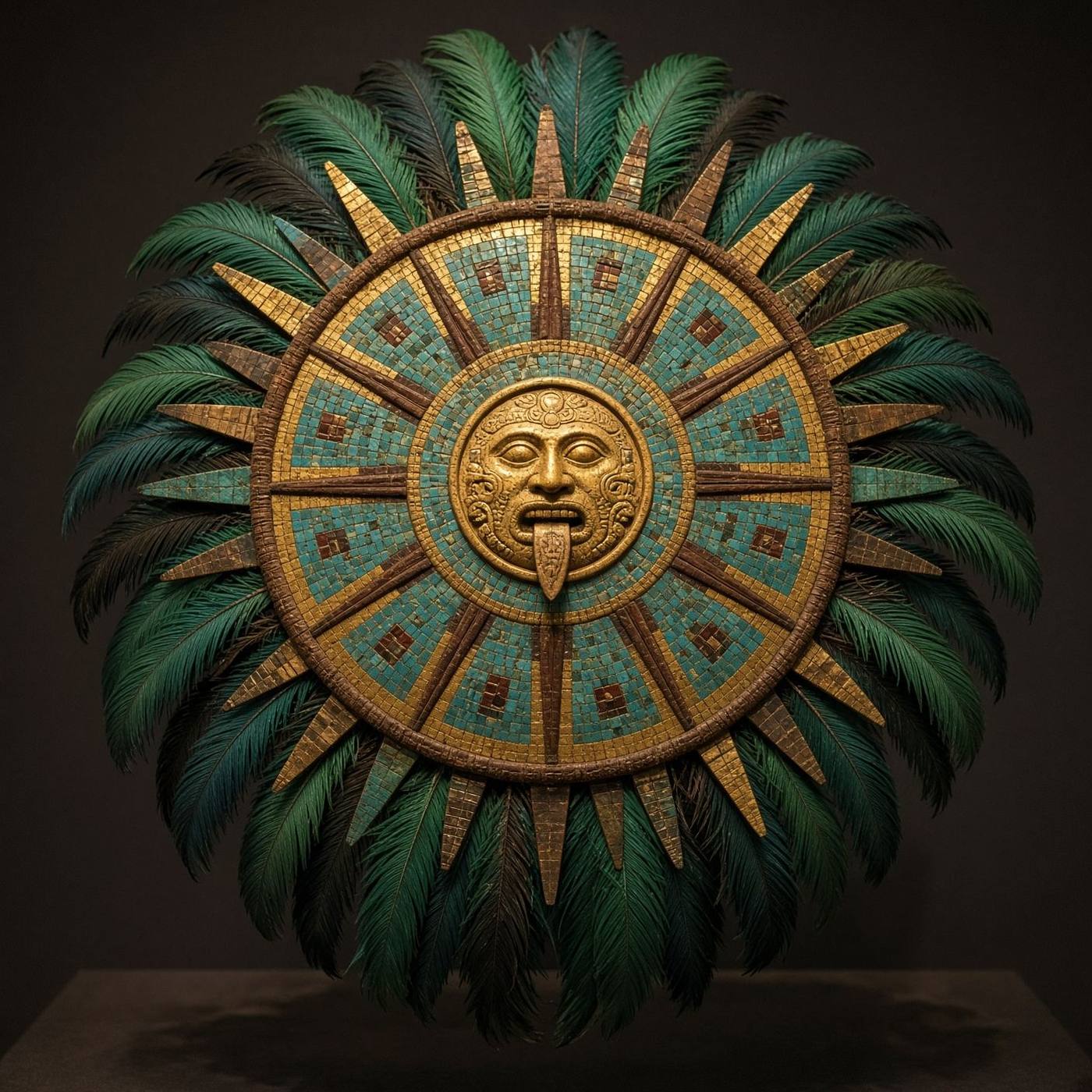
    Chimalli is Nahuatl for shield. Yaochimalli is a war shield. Māhuizzoh chimalli is a prestige or ceremonial shield (feather, gold, mosaic).

    Molina; Hassig, Aztec Warfare

  2. 02

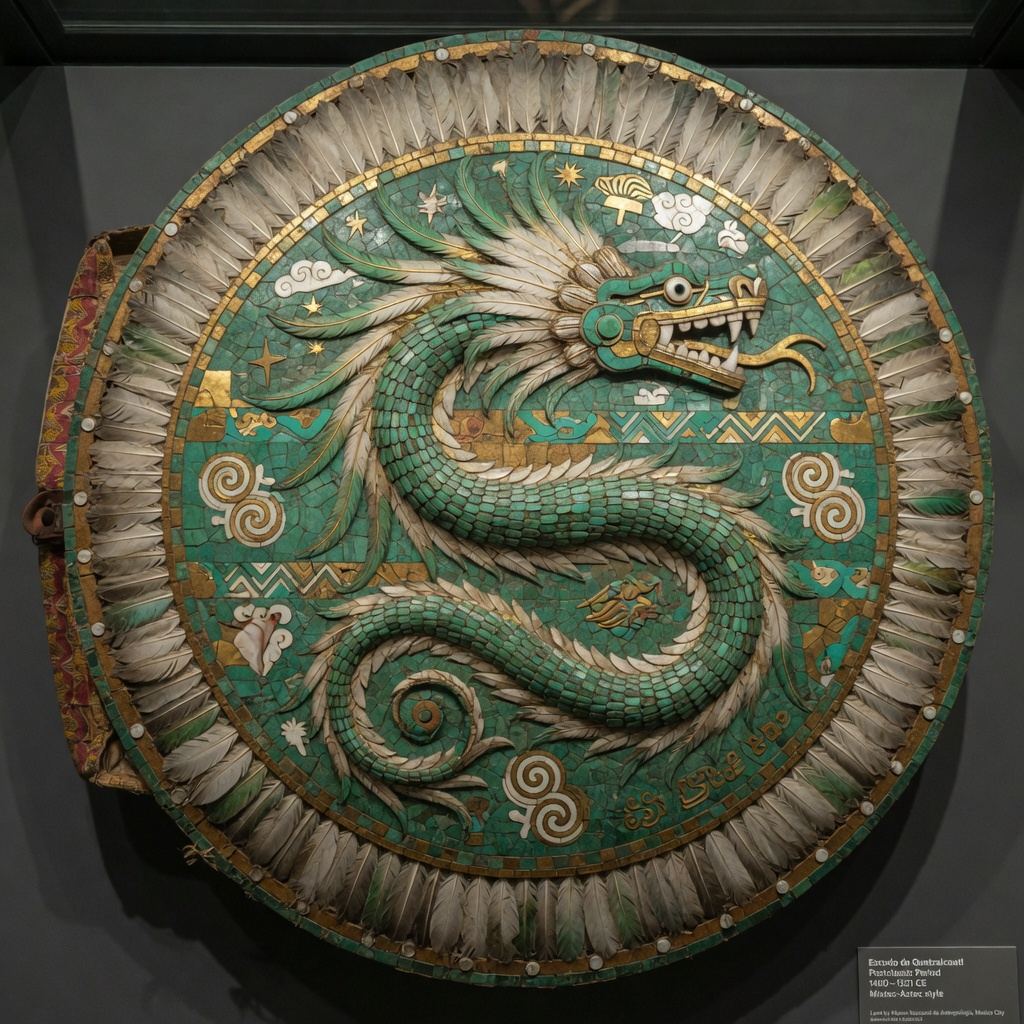
    A field chimalli was a round disc of woven cane or wood, faced with hide, often cotton padding, with two leather arm-straps on the back. Feather mosaic (amantecayotl) was applied by amanteca of Amantla.

    Sahagún, Book 9; Hassig

  3. 03

    War in Nahuatl is a pair: in mitl, in chimalli — the arrow and the shield. One word for the whole act.

    Difrasismo; Sahagún; Karttunen

  4. 04

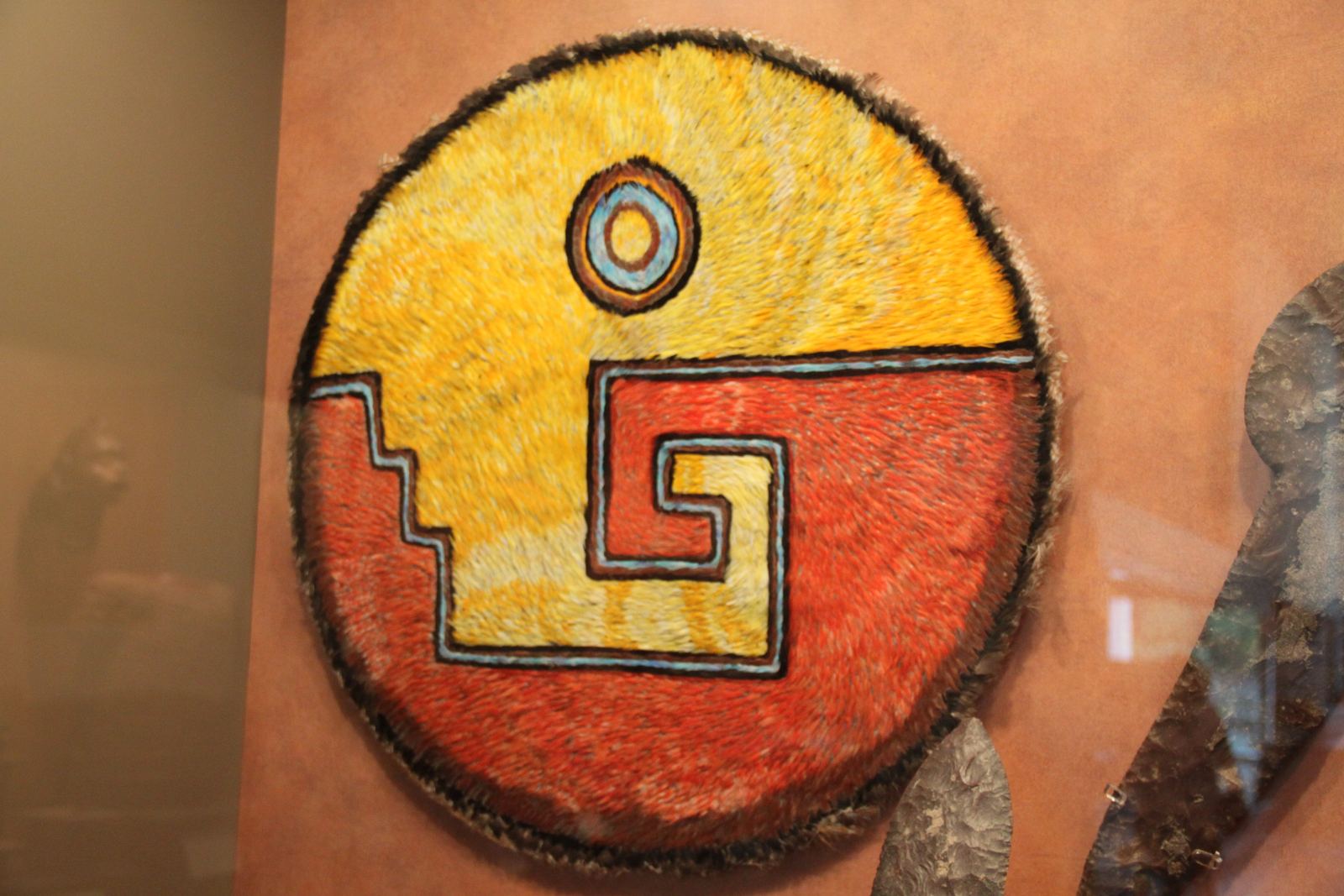
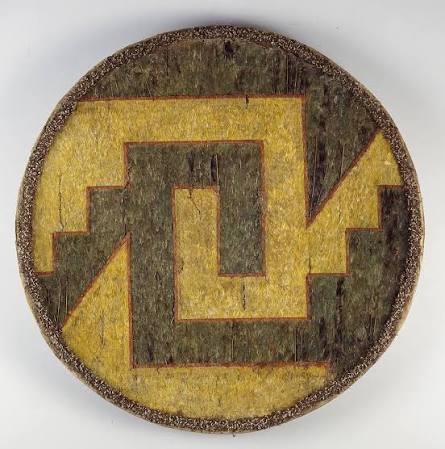
    Xicalcoliuhqui means twisted gourd: xicalli (gourd-bowl) + coliuhqui (twisted). The greca of right-angle stairs that reads, to a later eye, as a letter G. It is a chimalli device in Codex Mendoza, and an older highland motif (Teotihuacan, Mitla).

    Nahuatl morphology; Codex Mendoza tribute lists

  5. 05

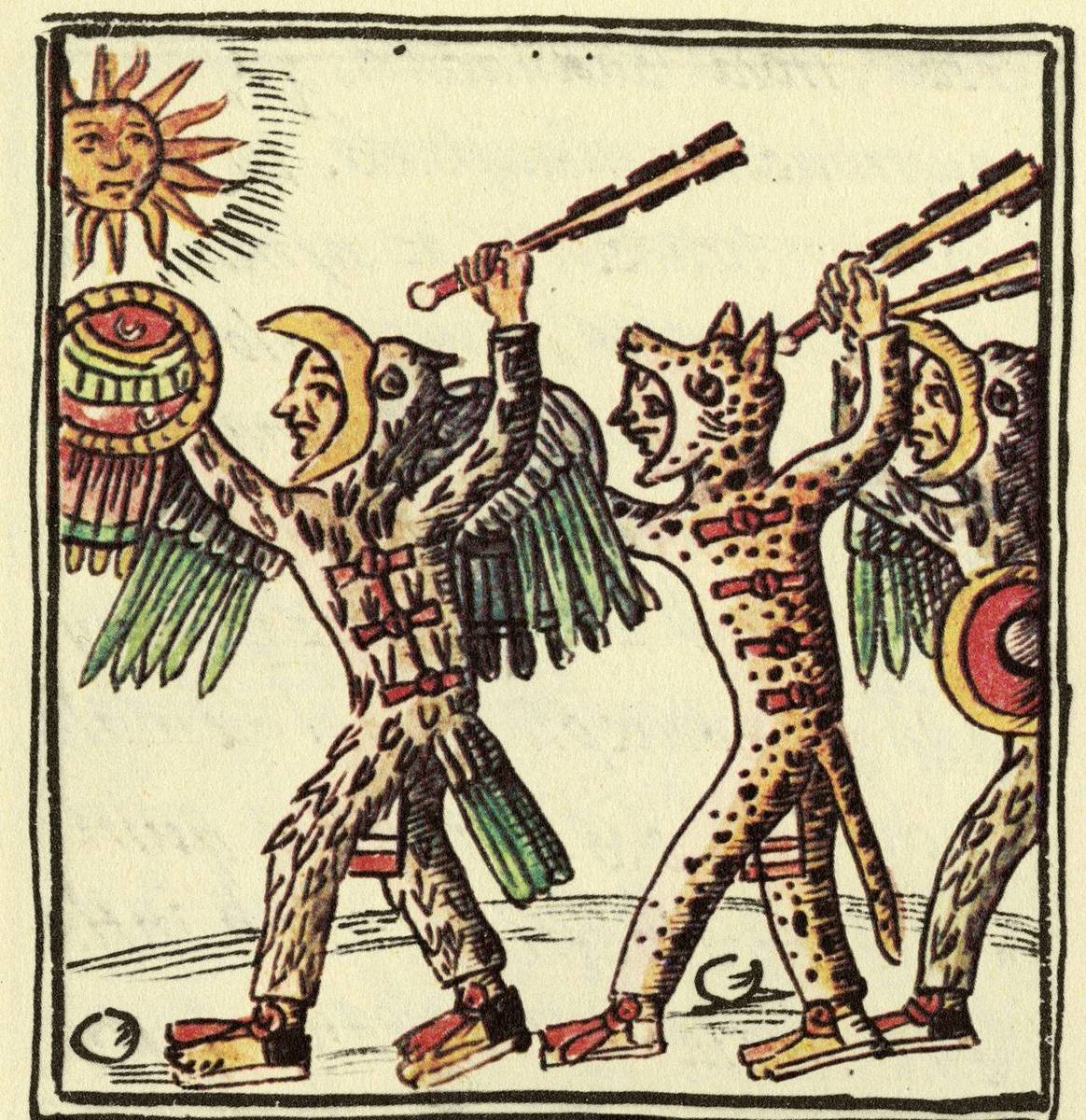
    Rank was counted in live captives. Codex Mendoza fol. 64r paints the sequence: first captive; two captives in Huastec (cuextecatl) dress with cuexyo chimalli; then higher tlahuiztli; eagle and jaguar; otontin; cuāchicqueh.

    Codex Mendoza, Bodleian Library, c. 1541; Berdan & Anawalt

  6. 06

    Xōchiyāōyōtl — flower war — was fought with Tlaxcala, Huexotzinco, and Cholula to take captives, train youth, and keep pressure on rivals. It was not bloodless.

    Sahagún; Durán; Hassig

  7. 07

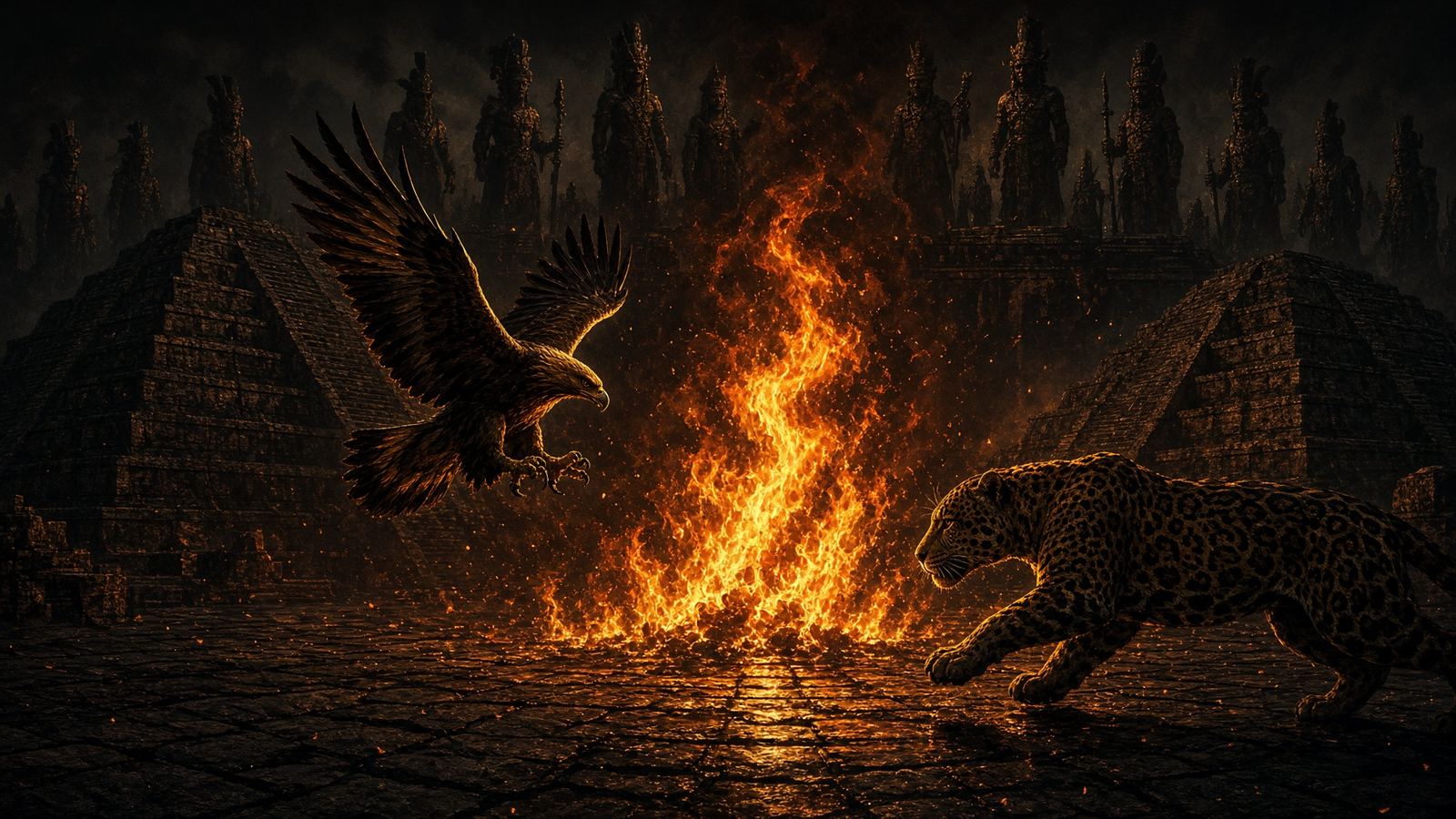
    Florentine Codex Book 7: after the sun was made at Teotihuacan, an eagle and a jaguar were sent into the same fire. The eagle's wingtips scorched; sparks spotted the jaguar. That is the charter the Mexica gave the two knightly animals.

    Sahagún, Book 7

  8. 08

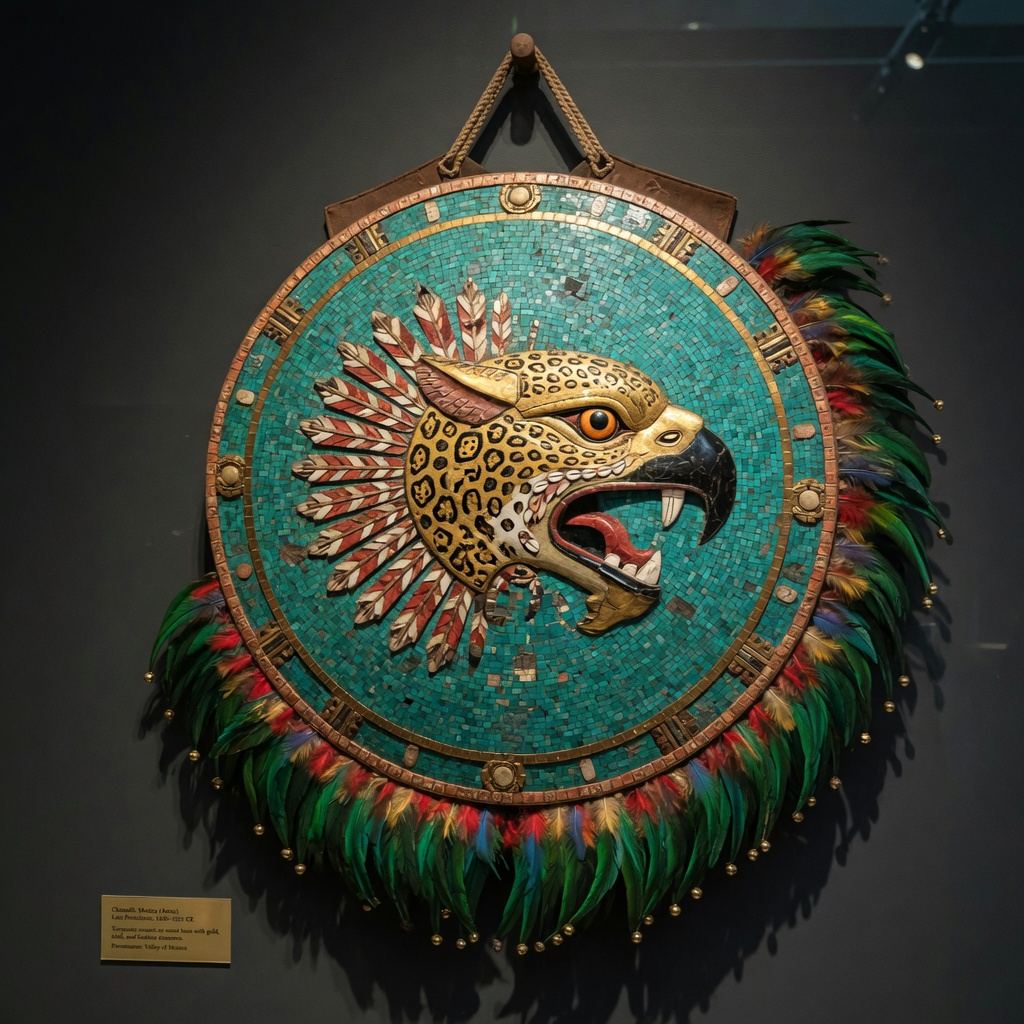
    A surviving feather chimalli with a coyote (sometimes called plumed coyote / ahuizotl type) is in the Weltmuseum Wien: wood, bamboo, paper, feather mosaic, gold, about 1500. Photograph on this page is of that object.

    Weltmuseum Wien; photo Richard Mortel, CC BY 2.0

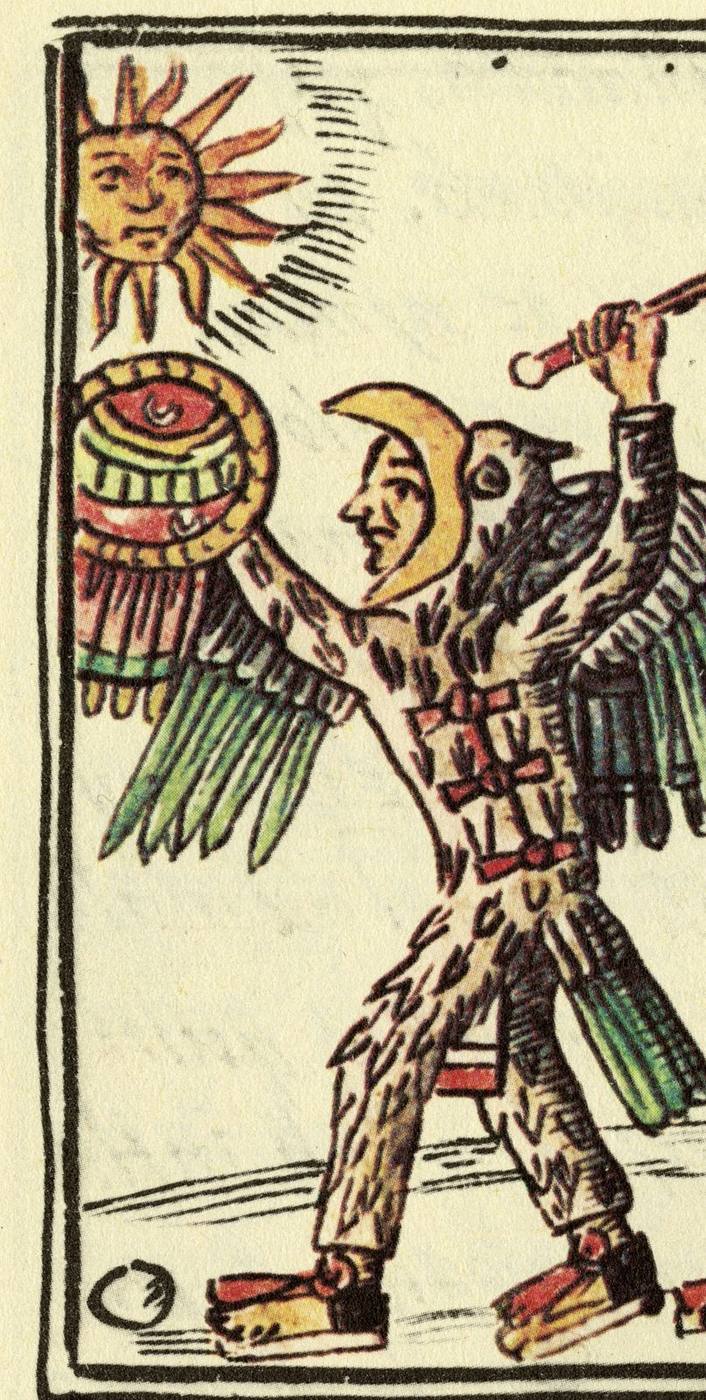
Codex Mendoza · fol. 64r · c. 1541

The book

Bodleian Library. Public domain. This folio is how Mexica rank was painted for the Spanish: captives, costumes, chimalli. Not a modern drawing.

Codex Mendoza folio 64r, warrior ranks and chimalli
  • Eagle knights of the Mexica

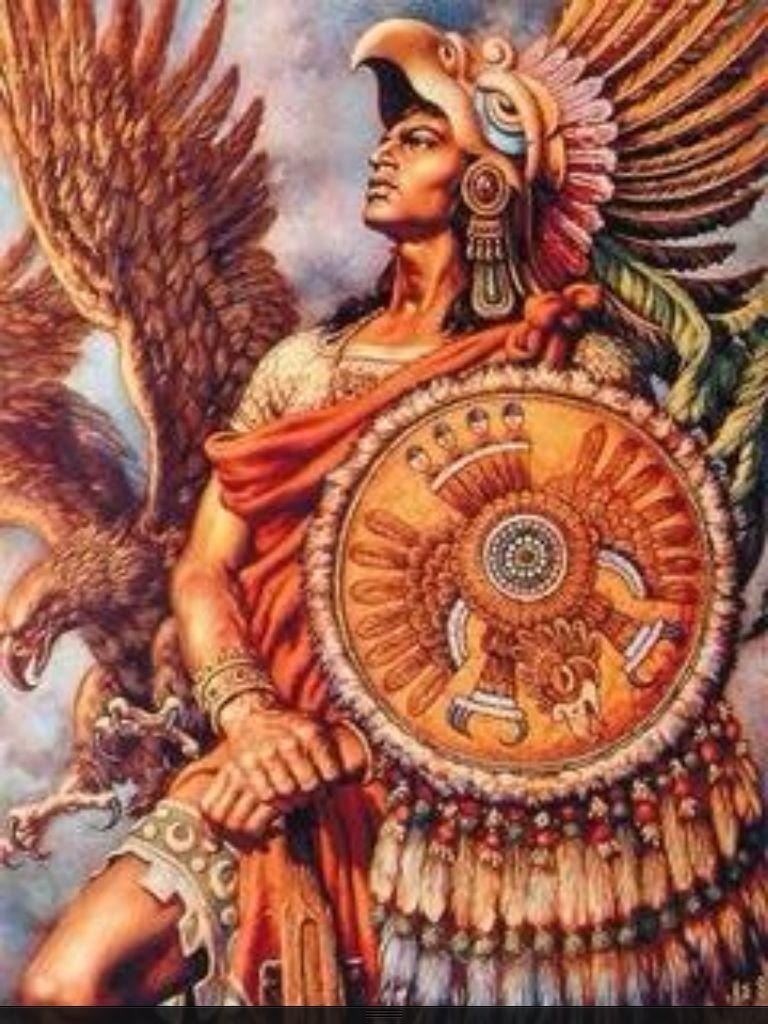
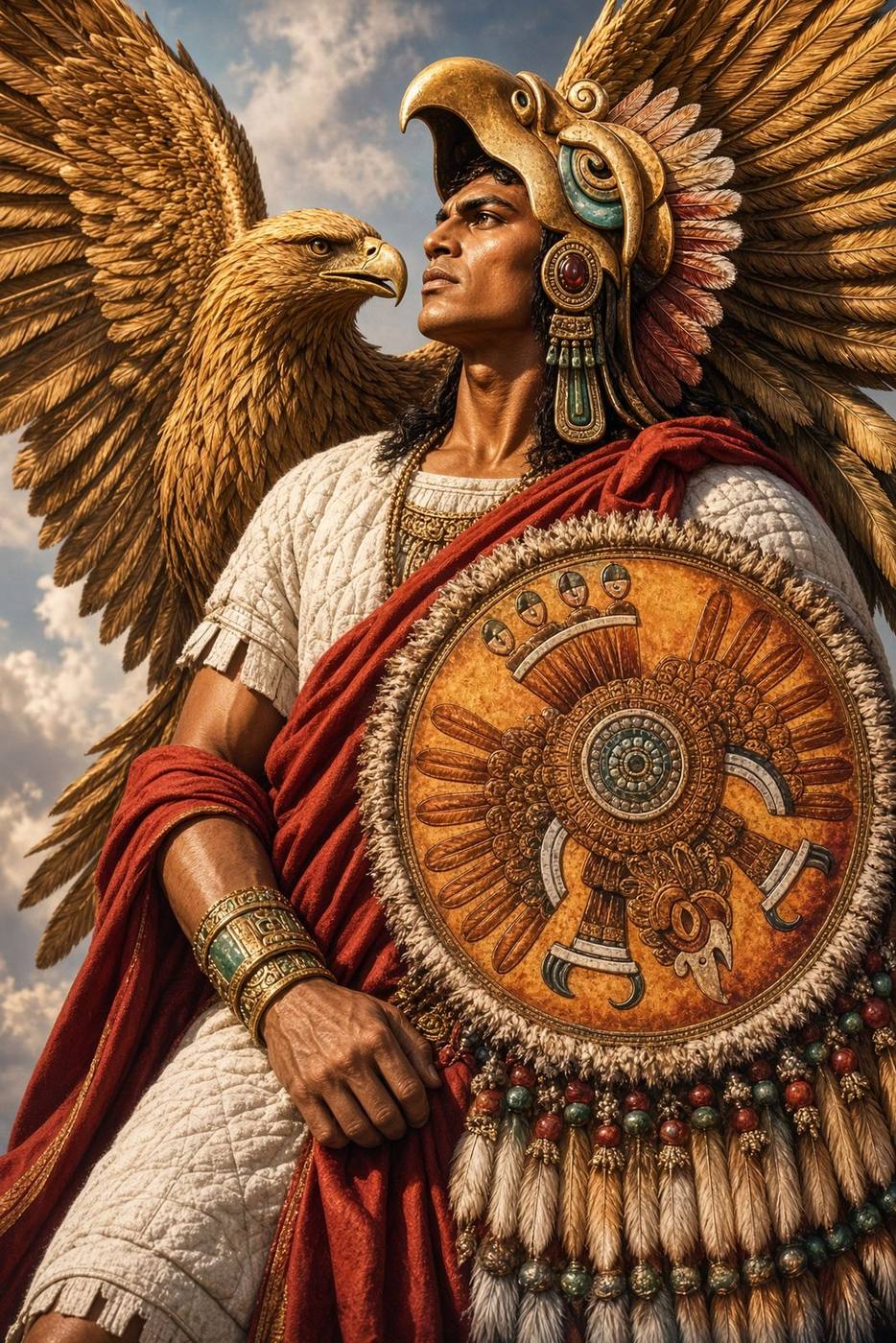
    Modern painting · Huitzilopochtli · Cuāuhtli — Eagle

    Cuāuhtin

    Eagle knights

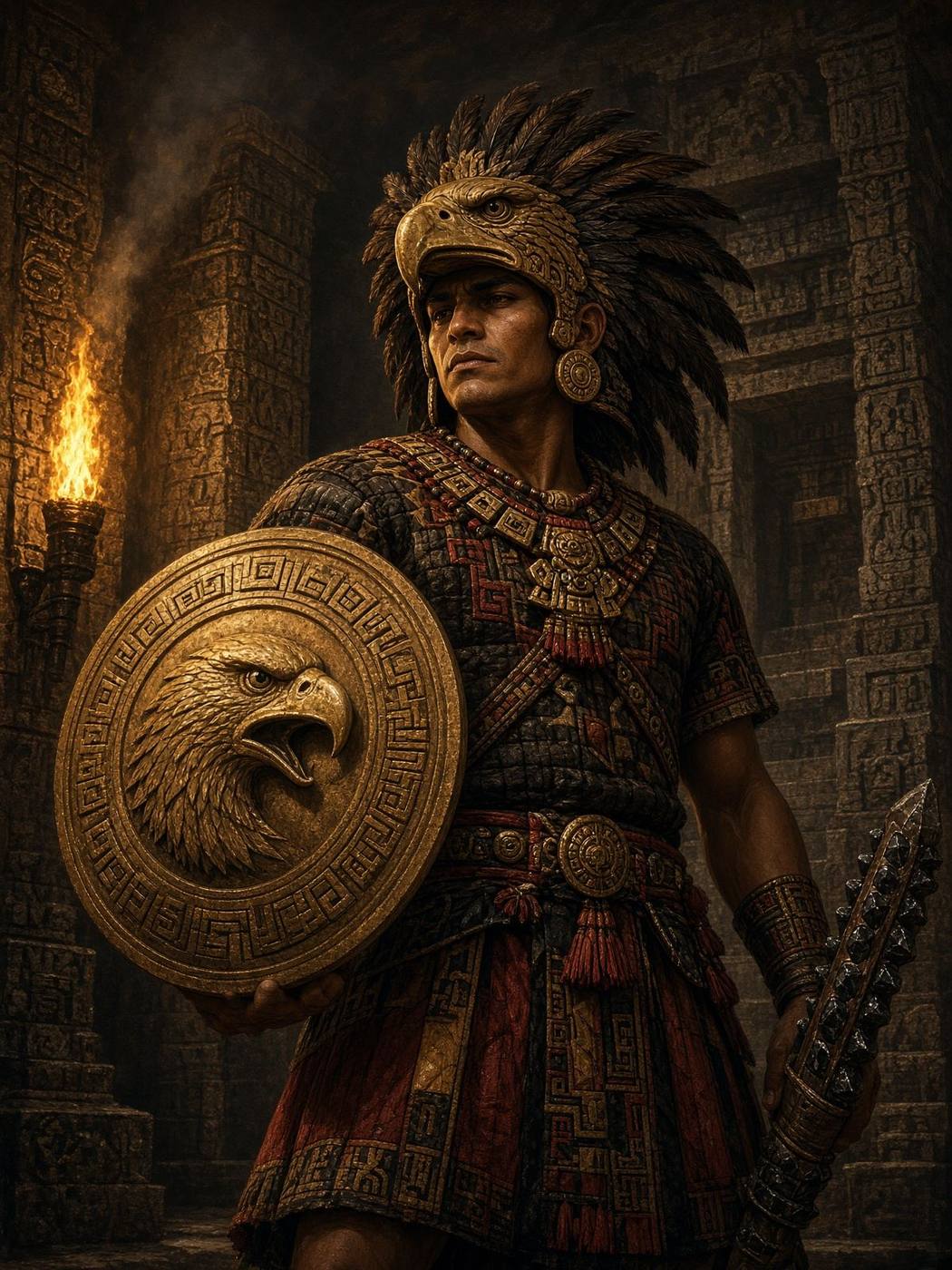
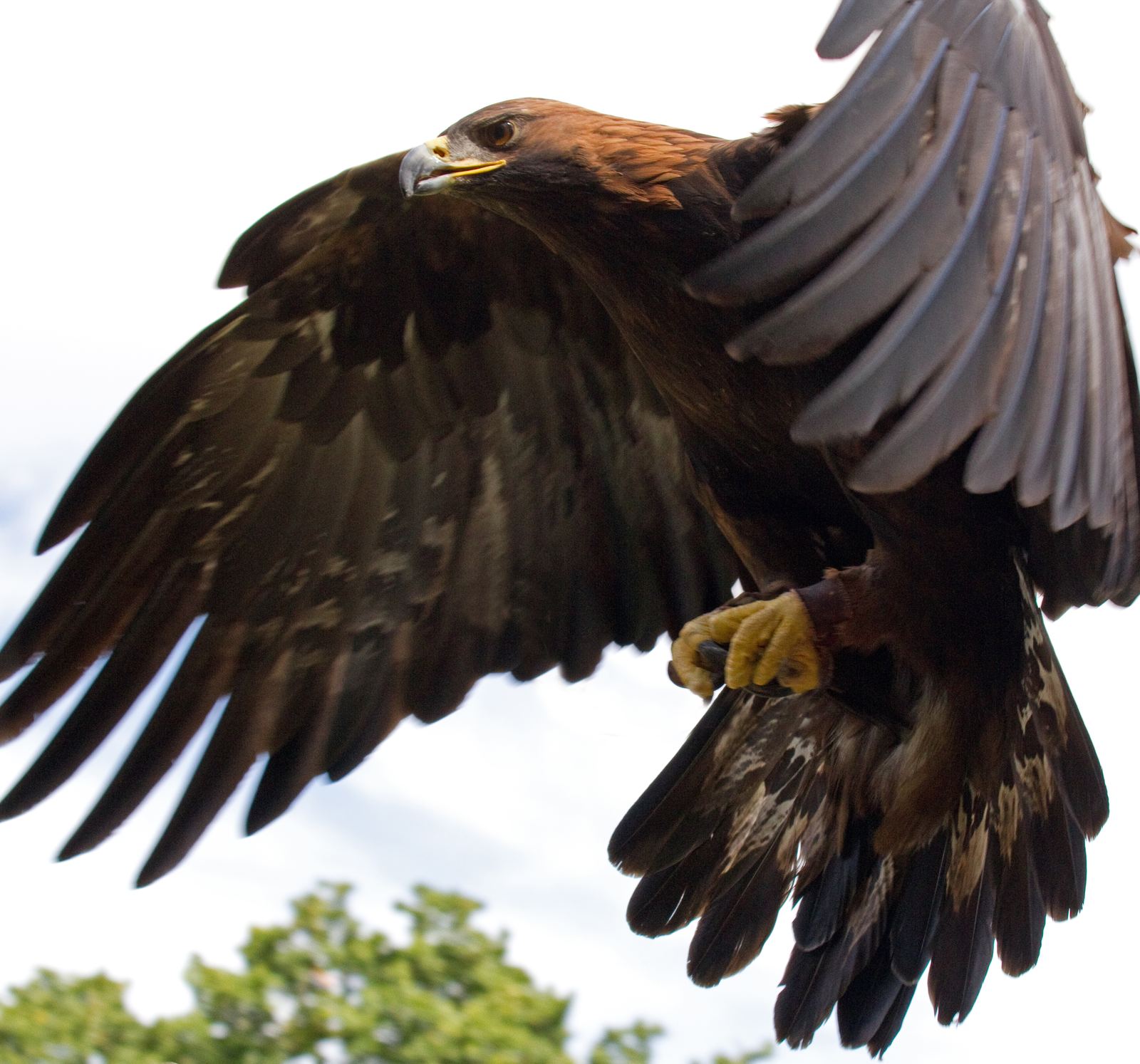
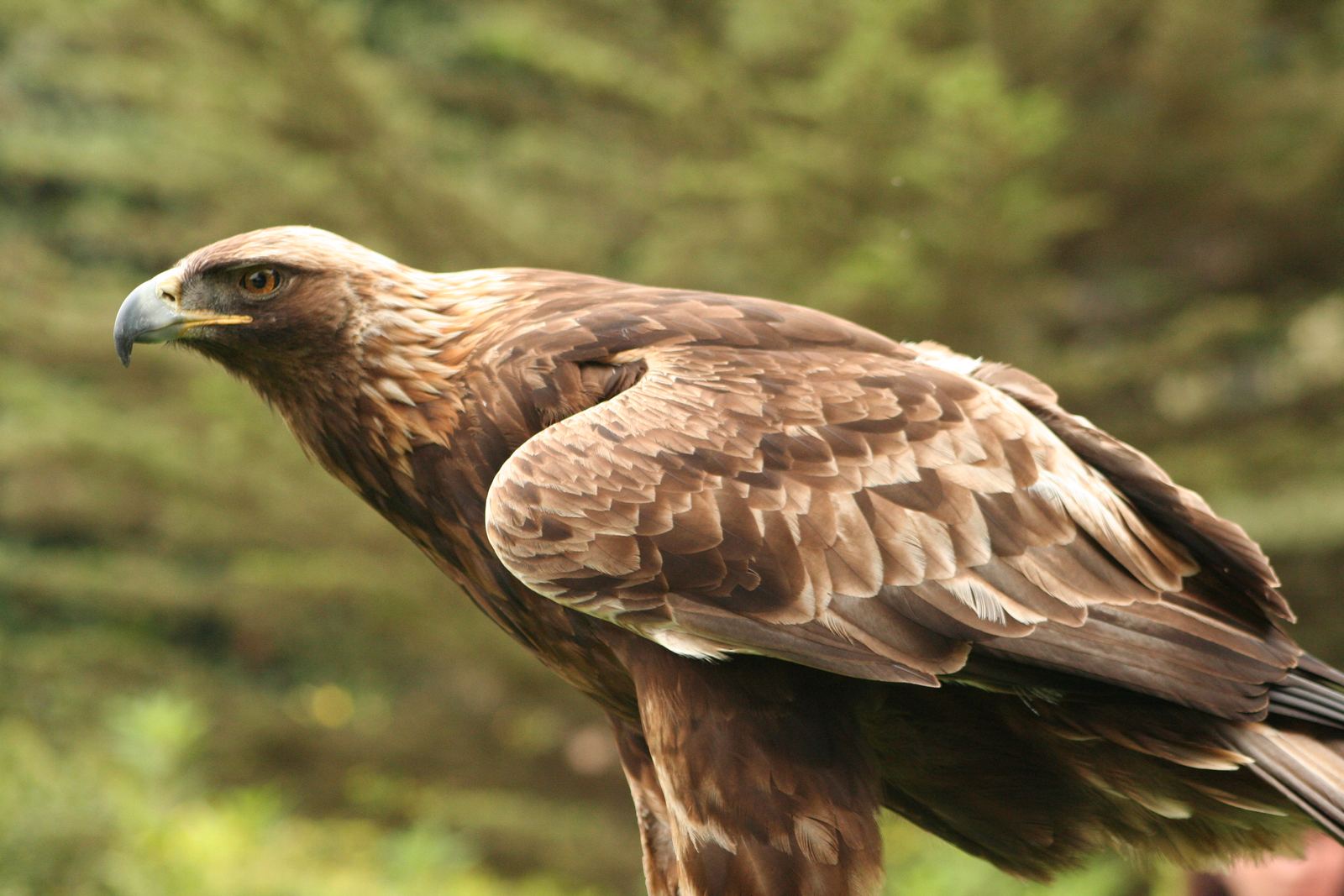
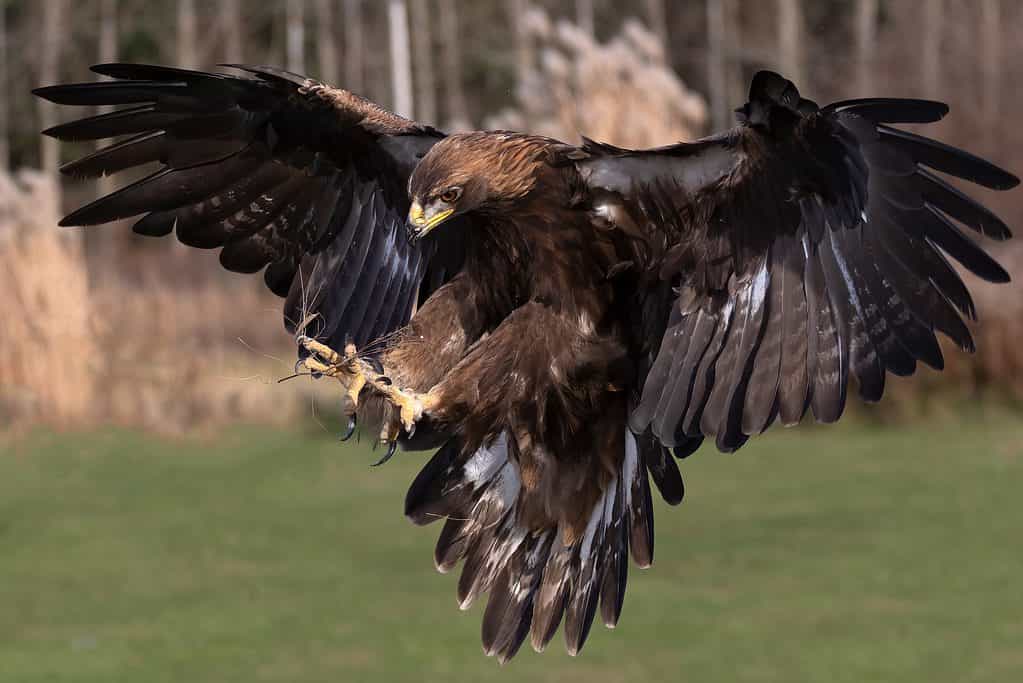
    The eagle belongs to the sun. Eagle knights fought in the day's heat, in feathered helmets that turned a man into Huitzilopochtli's own bird. Rank in the Mexica army was not bought. It was taken in the field: a warrior who captured enough enemies could enter the order, wear the cuāuhpipiltin costume, and sit nearer the tlatoani. The Florentine Codex paints them as the daylight face of Mexica war — public, loud, meant to be seen.

  • Jaguar knights of the Mexica

    Modern painting · Tezcatlipoca · Ocēlōtl — Jaguar

    Ocēlōmeh

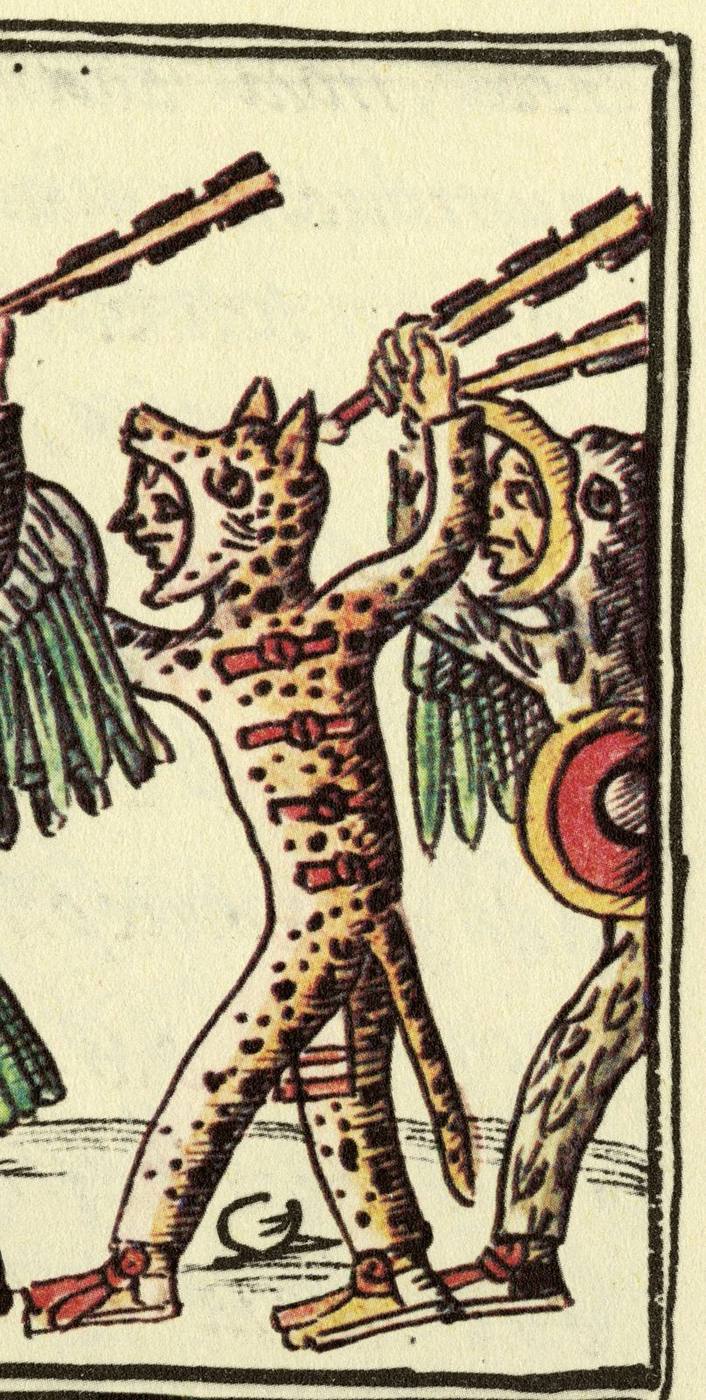
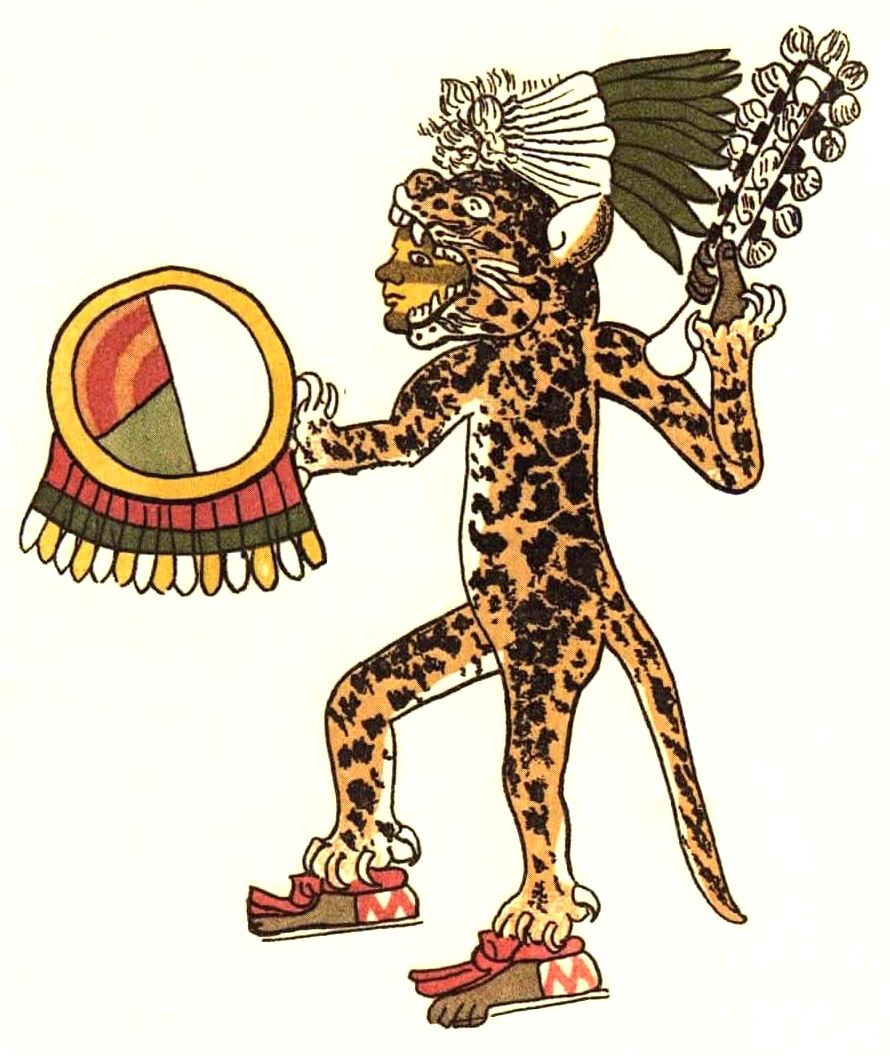
    Jaguar knights

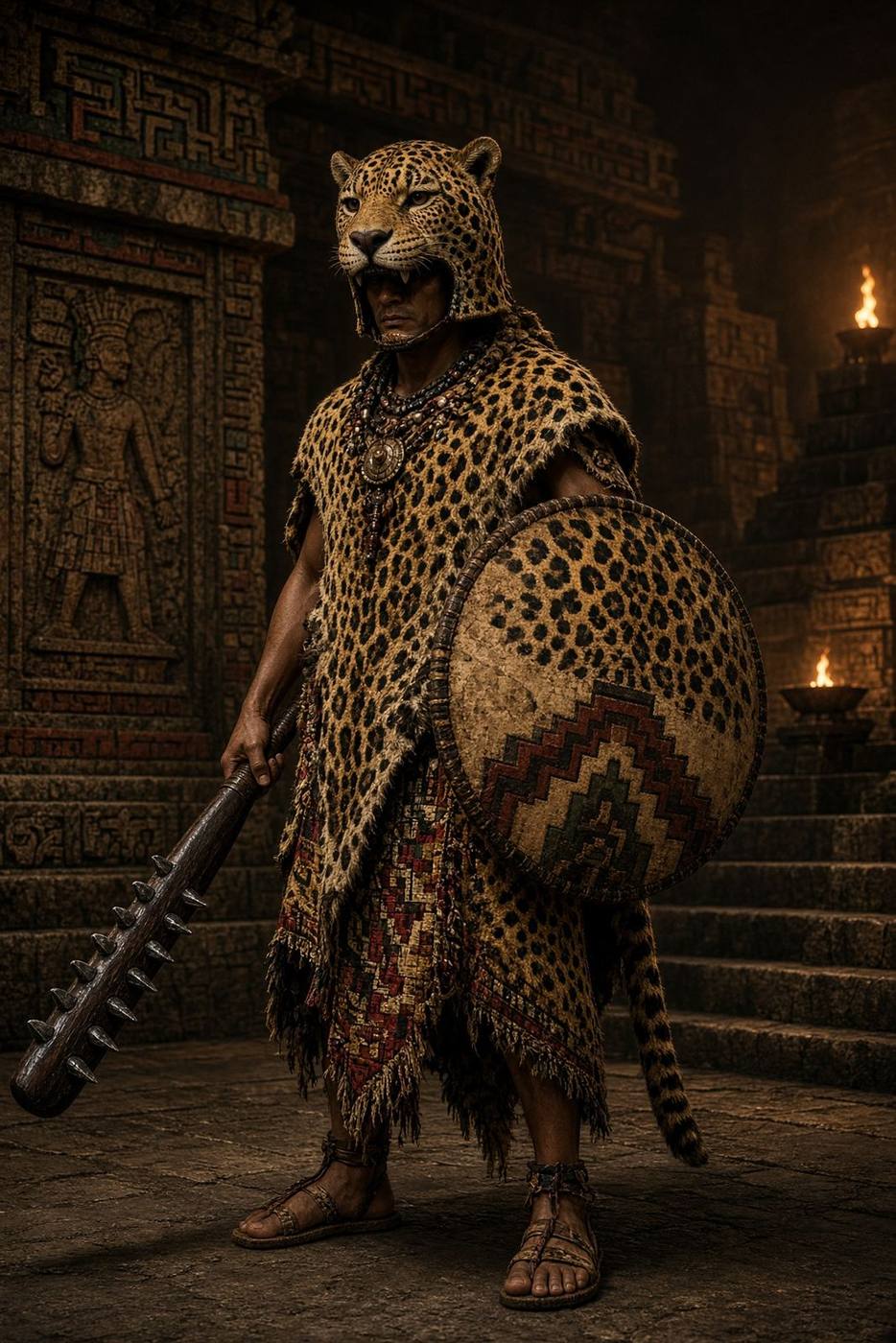
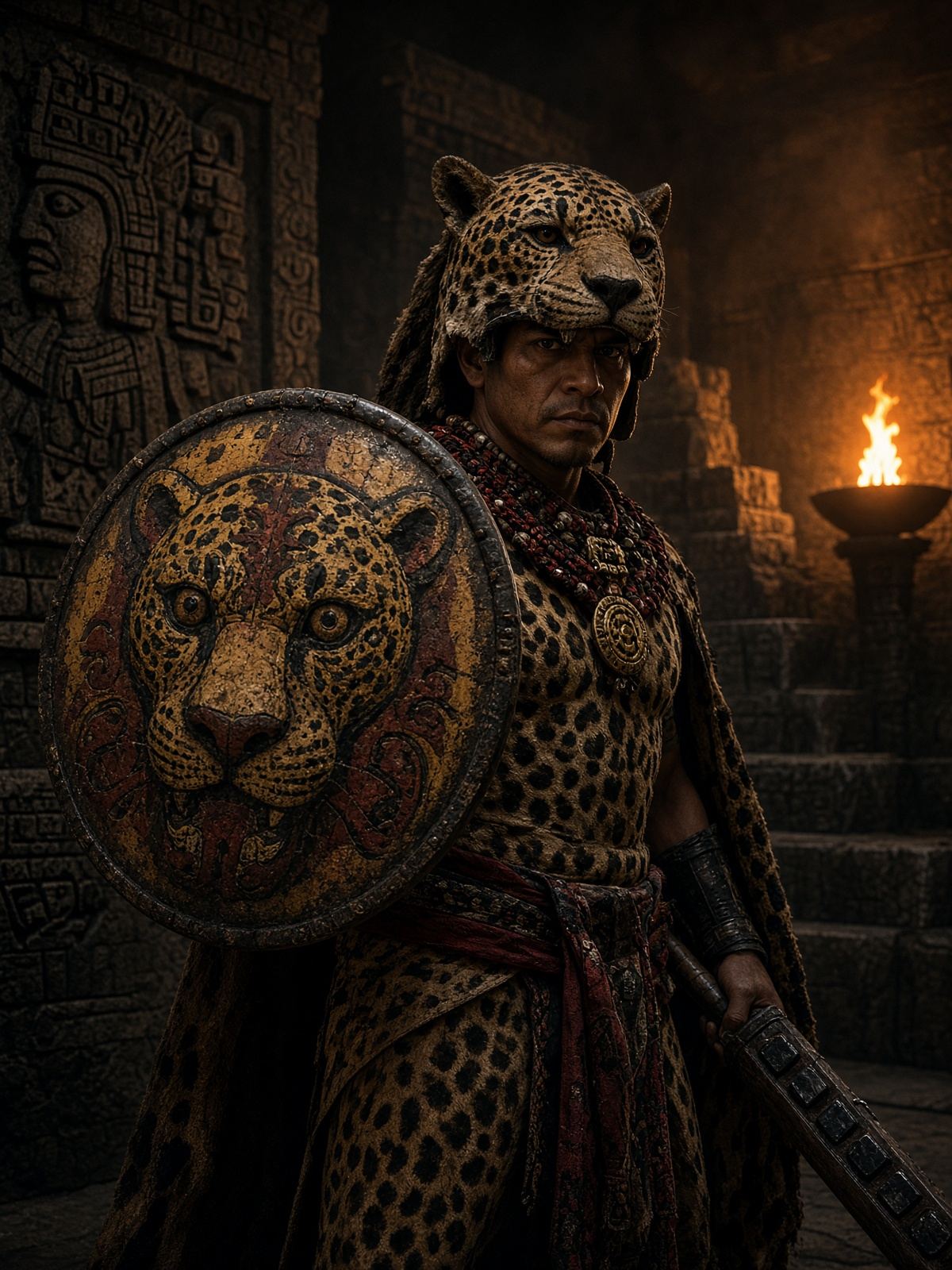
    The jaguar belongs to the night and to Smoking Mirror. Jaguar knights wore the whole pelt, head and all, and fought as the forest's unseen king. They were the other half of the same elite: cuāuhocēlōtl — eagle and jaguar together — the two animals the Mexica used when they meant a complete warrior. Capture, not a body count, opened the door. The spotted cloak was a rank you earned, then had to keep.

Mexica chimalli — the shield that names a warrior

Chimalli · chee-MAH-lee

The shield is a name

In mitl, in chimalli

A Mexica shield is not only what stops a dart. It is what a man shows. The device painted on the chimalli — step-fret, solar disc, the animal of his order — is how the field reads him. Without it he is a body. With it he is a word.

Nahuatl says war as a pair: in mitl, in chimalli. The arrow is what you send. The shield is what you are. One without the other is half a sentence. The same grammar that says art as in xōchitl, in cuīcatl — flower and song — says war as arrow and shield. Two halves, one act.

Chimalma, one of the four who carried Mexi from Aztlan, is named for this: shield-hand. The people walked with a god in a bundle and a shield in a woman's grip. Protection was not an afterthought of empire. It was in the first four names.

In ōmpa Stuttgart

The ones that still exist

Cane and feathers rot. A handful of chimalli survive in European cases. The coyote in Vienna is the object itself. The G in the vitrine is the object itself. Codex Mendoza is the book. We do not redraw those.

  • Coyōchimalli — Coyote mosaic — Weltmuseum Wien

    Coyōchimalli

    Coyote mosaic — Weltmuseum Wien

    The object itself. Wood, cane, paper, feather mosaic, gold. A plumed coyote, about 1500. Now in Vienna. Ahuitzotl's kind. Photographed in the museum. Not a drawing.

  • Xicalcoliuhqui īyōllō — The G with a sun-heart — as it sits in the case

    Xicalcoliuhqui īyōllō

    The G with a sun-heart — as it sits in the case

    Yellow mosaic, the greca, stairs, a concentric disc at the navel. This is the chimalli from the vitrine, unaltered. Sun or chalchihuitl at the heart of the stairs.

  • Xicalcoliuhqui — The G as the pattern is drawn

    Xicalcoliuhqui

    The G as the pattern is drawn

    The stairs coiled into a disc, pantli hanging. This is the xicalcoliuhqui chimalli as a clean rendering of the real type — yellow field, black greca, feathers below.

  • Cuexyo chimalli — Huastec crescents

    Cuexyo chimalli

    Huastec crescents

    Four gold U-shapes, hanging pendants. Codex Mendoza gives this to the two-captive warrior. The crescents are how the field read cuextecatl.

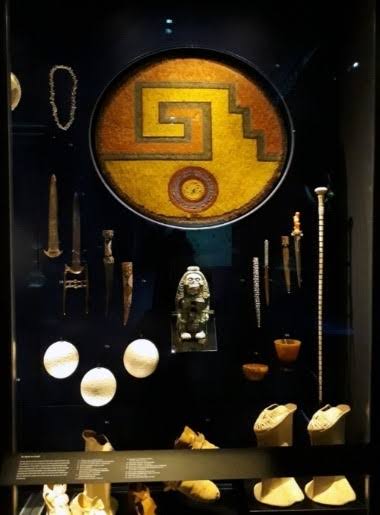
In the glass

How a chimalli sits now

Dark case. Spotlight. Knives, jade, sandals, shell. The G in the middle. The photograph is the case as shown — not a redrawing.

Museum case with a xicalcoliuhqui chimalli at the center, as shown
Xicalcoliuhqui chimalli from the case, unaltered
  1. 01

    Chimalli

    The shield in the glass

    Yellow mosaic, the G, stairs on the right, a concentric disc at the bottom — sun or chalchihuitl at the navel of the greca. Museums hang it in the dark so the feathers do not fade. This is how most of us will ever see one.

  2. 02

    Tecpatl

    Flint / obsidian knife

    A day-sign and a tool. Priests used it. Warriors carried one. The blade is volcanic glass. It sits in the case because a chimalli is only half of in mitl, in chimalli — the other half is what you send.

  3. 03

    Chalchihuitl

    Jade beads

    Water, preciousness, a heart that does not rot. A necklace in the same vitrine as a war shield is not random. Rank wore green stone. The dead were given it too.

  4. 04

    Cactli

    Sandals

    A person of station. Captives were stripped of them. The pair at the bottom of the case is the walk: from the telpochcalli to the field, and home if the sun allowed it.

  5. 05

    Ehecacōzcatl

    Wind jewel / shell discs

    White discs of shell. Quetzalcoatl wears the wind jewel. On a warrior they are ornament and a name. Three of them in a case read as breath, next to a shield that does not breathe.

Xicalcoliuhqui chimalli · shee-kal-ko-LEE-oo-kee chee-MAH-lee

The shield that looks like a G

Eagle knight holding the xicalcoliuhqui, the G of stairs

People who did not grow up with the books see a letter G. The Mexica saw stairs. A thick band that turns at right angles, like the steps of a teocalli, then coils into the disc. The opening of the coil is why it reads as a G. Xicalli is a gourd-bowl; coliuhqui is twisted.

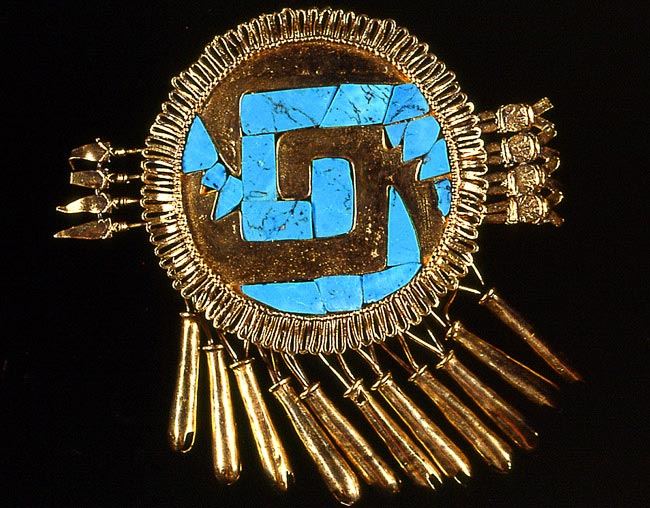
This is the chimalli the tribute lists actually name. Codex Mendoza paints it yellow, with a green greca, a red band, and a hanging fringe of feathers — pantli — so the field could read the man before he closed. Provinces sent these by the score: cane core, hide, paint or feather mosaic. In mitl, in chimalli — the darts on one side of the gold type are the other half of the sentence.

Almost none survive. Feathers and cane rot. The coyote chimalli in the Weltmuseum Wien is the object itself — mosaic, about 1500. The G in the vitrine is the object itself. Codex Mendoza is the book the empire painted. Those are not redrawn here.

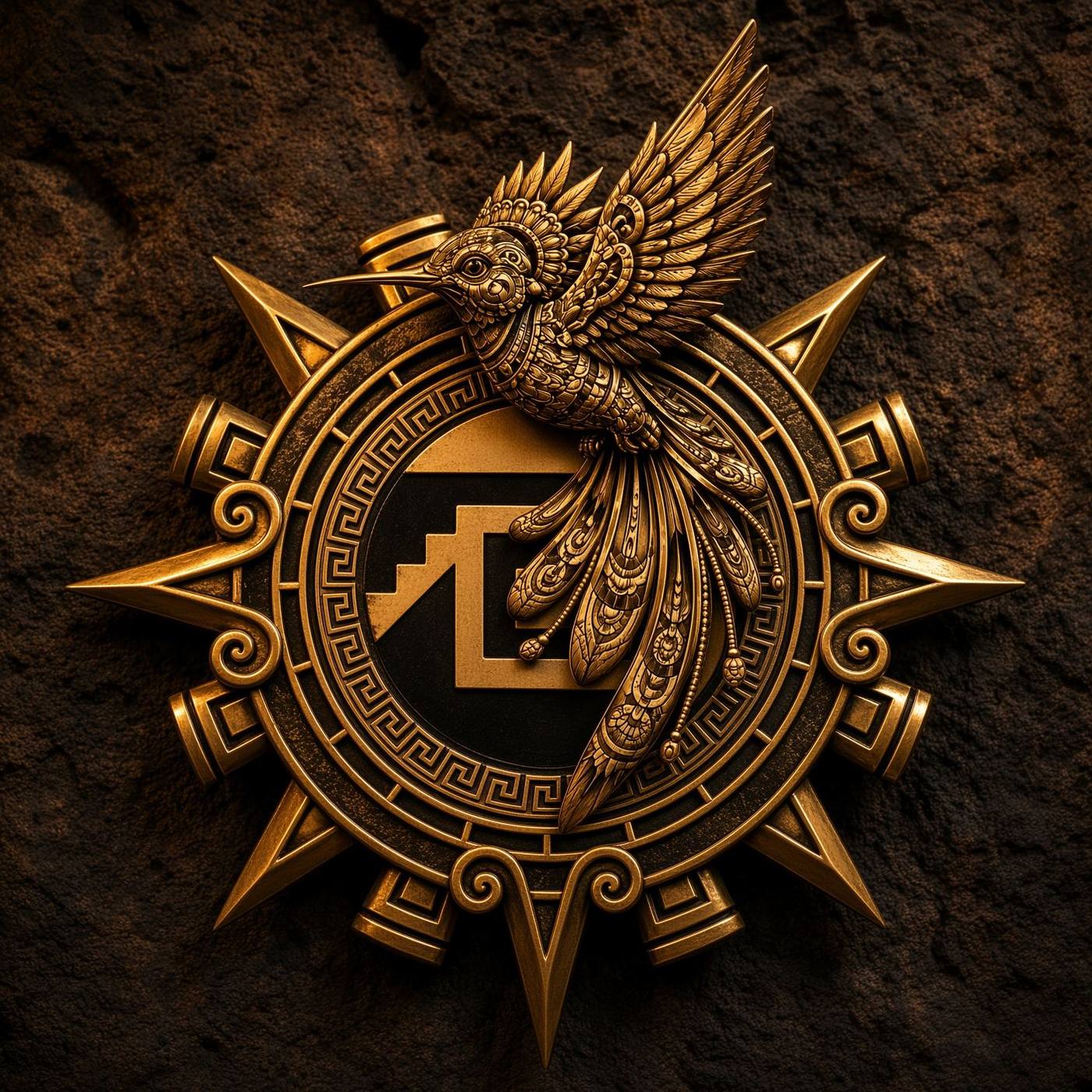
The hummingbird sitting on this G — and Hunab Ku, which is the same stairs with another name — are in Signs.

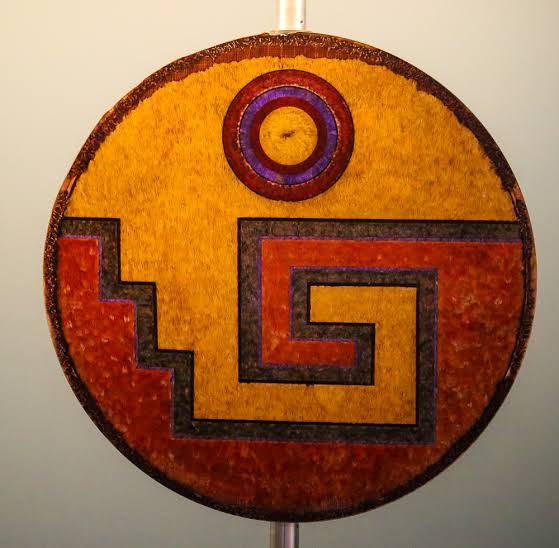
Xicalcoliuhqui chimalli with sun disc above pyramid stairs

The chimalli in the case, as shown. G, stairs, sun-heart.

Codex Mendoza folio 64r — warrior ranks and chimalli

Codex Mendoza, folio 64r. The book itself. Rank and chimalli as painted.

  • Sun over the stairs

    Tōnatiuh īpan teōcalli

    Sun over the stairs

    Concentric disc at the top — sun, or jade. Pyramid stairs on the left. The G below. The temple and the Fifth Sun on one chimalli.

  • The G with hanging feathers

    Xicalcoliuhqui

    The G with hanging feathers

    Yellow disc, black stairs, pantli below. The chimalli as the type is drawn — unaltered.

  • Feather mosaic — the kind that survives

    Ihuitl xicalcoliuhqui

    Feather mosaic — the kind that survives

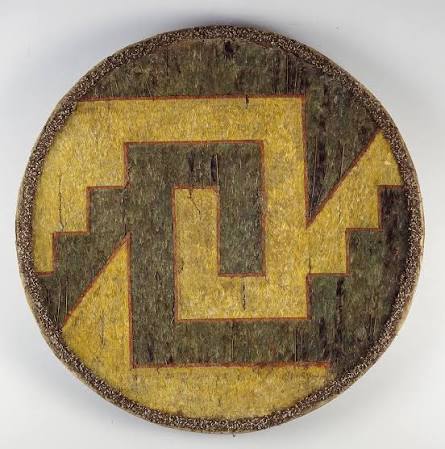
    Amanteca work. Yellow and olive feathers, down rim. Stuttgart keeps this type. Almost the only G you can still touch.

  • Tribute shield, as the book paints it

    Mendoza chimalli

    Tribute shield, as the book paints it

    Cream paper, yellow field, green G, red band, yellow fringe. How the empire counted them.

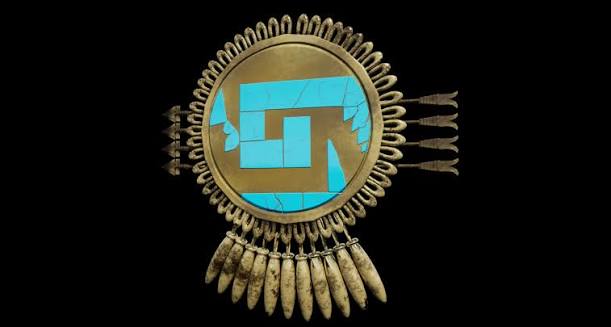
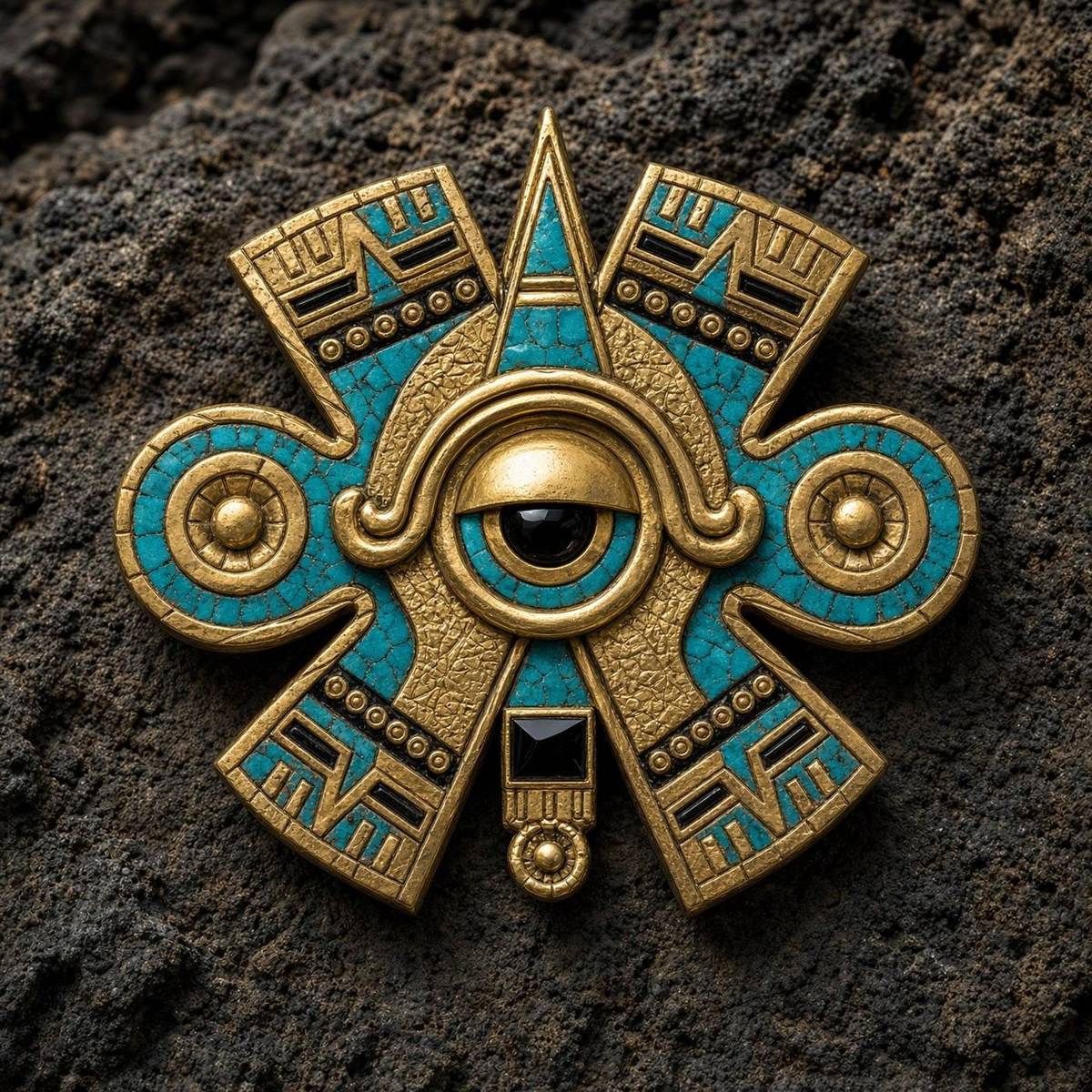
  • Gold and turquoise mosaic

    Teocuitlachimalli

    Gold and turquoise mosaic

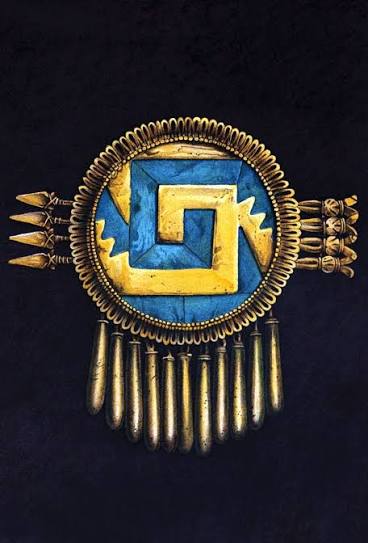
    The G in gold on fire-stone. Darts on the left — mitl. Pendants below. Ceremony, not mud.

  • G with a solar heart

    Tōnatiuh xicalcoliuhqui

    G with a solar heart

    Stairs around concentric rings. The year inside the greca.

  • G with a sun at the heart

    Xicalcoliuhqui īyōllō

    G with a sun at the heart

    The object in the case. Greca, stairs, concentric disc at the navel. Unaltered.

  • Four G's, one sun

    Nauhxicalcoliuhqui

    Four G's, one sun

    Four quarters, four coils. The year as four stairways.

Cuāuhtli · Ocēlōtl · Huitzillin

Eagle, jaguar, and the hummingbird's own

Two orders, one patron. The eagle knight holds the day. The jaguar knight holds the night. Huitzilopochtli's chimalli is not a rank — it is the god's name on an arm.

Eagle warrior shields — warrior with chimalli

Huitzilopochtli · Tonatiuh

Cuāuhtin

Eagle warrior shields

The eagle knight does not hide his chimalli. The most Mexica disc he can hold is the xicalcoliuhqui — the G of stairs. Down-balls (ihuiteteyo) around other rims are the war-god's tufts. Concentric gold is the day's heat. The spread eagle is the bird that went into the fire.

  • The G of stairs

    Xicalcoliuhqui

    The G of stairs

    Stepped spiral, hanging feathers. The eagle knight's most-seen chimalli.

  • Spread-eagle shield

    Cuāuhchimalli

    Spread-eagle shield

    The bird of the Fifth Sun, wings open so the field cannot mistake the order.

  • Eagle shield with down-balls

    Ihuiteteyo cuāuhtli

    Eagle shield with down-balls

    White down around the eagle. Priest-war. The same tufts on Huitzilopochtli's own chimalli.

  • Solar eagle shield

    Tōnatiuh chimalli

    Solar eagle shield

    Rings of gold and crimson. The knight as a moving sun. Daylight war, meant to be counted.

Jaguar warrior shields — warrior with chimalli

Tezcatlipoca

Ocēlōmeh

Jaguar warrior shields

The jaguar knight shows the night. One chimalli is the face of the animal. One is the whole pelt, with an obsidian heart. One is Smoking Mirror — Tezcatlipoca's seeing — set in the spotted field. Capture opened this door. The shield kept it open.

  • Jaguar-face shield

    Ocēlōchimalli

    Jaguar-face shield

    The First Sun looking back at you. You do not hide behind this. You show the eater.

  • Pelt shield

    Ocēlōehuatl chimalli

    Pelt shield

    The whole hide as a disc. Obsidian at the navel. Night you can hold.

  • Smoking-mirror jaguar shield

    Tezcatl ocēlōtl

    Smoking-mirror jaguar shield

    Spots around an obsidian glass. The god who sees, carried on the arm.

Shields of the hummingbird of the left — warrior with chimalli

Mexi · the patron

Huitzilopochtli

Shields of the hummingbird of the left

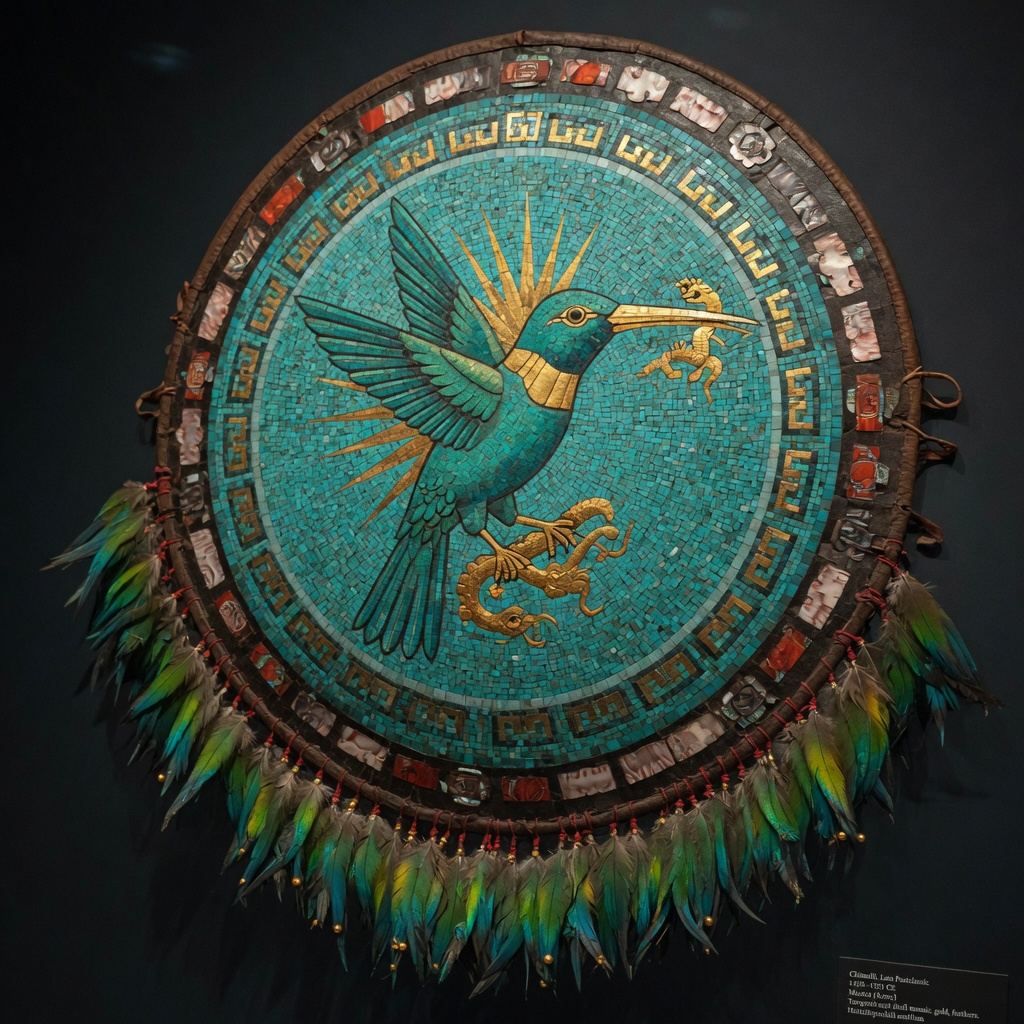
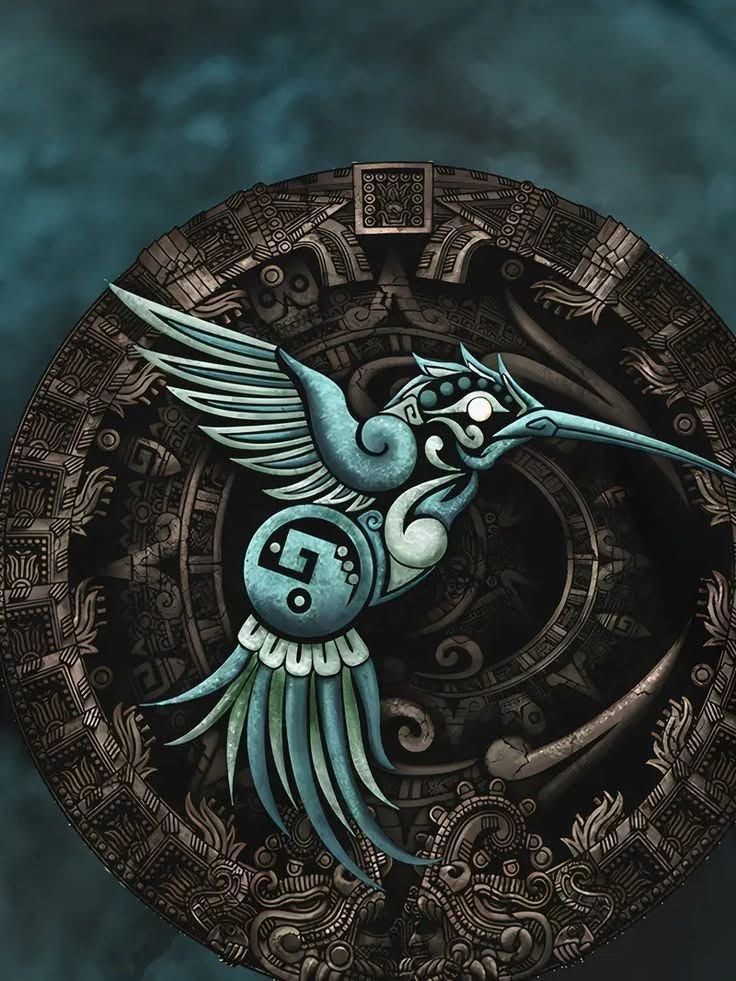
These are not a rank you buy with captives. They are the god's own devices, carried by his priests and his captains at Panquetzaliztli. Blue and white down. The fire-serpent. Water and burnt earth — teoatl, tlachinolli — the old picture for war itself. The hummingbird on the field is the name we took.

  • Hummingbird shield

    Huitzilchimalli

    Hummingbird shield

    Mexi's bird on a blue field. The left-hand, the south, the thorn-side.

  • Down-ball war-god shield

    Ihuiteteyo chimalli

    Down-ball war-god shield

    Deep blue, white down-balls, a gold heart. The chimalli painted for Huitzilopochtli in the books.

  • Fire-serpent shield

    Xiuhcōātl chimalli

    Fire-serpent shield

    The weapon he was born with, coiled as a disc. Turquoise fire around a sun.

  • Sacred water, burnt earth

    Ātl tlachinōlli

    Sacred water, burnt earth

    The glyph for war: water-scroll and fire-scroll on one chimalli. Not a metaphor. The name of the act.

Tlahuiztli

All the warrior shields

The chimalli changed as the count of captives changed. Codex Mendoza paints that road. The discs below are modern paintings after those types — not the surviving objects. The objects are above.

  • Yāōchimalli — War shield of the first captive

    1 captive

    Yāōchimalli

    War shield of the first captive

    yah-oh-chee-MAH-lee

    Yāōqui — a man who has been to war

    Cane, hide, maguey. A small sun painted so the field can see you at all. This is the first name. Without it you are only a body in the dust.

  • Cuexyo chimalli — Huastec shield

    2 captives

    Cuexyo chimalli

    Huastec shield

    KWEH-sho chee-MAH-lee

    Cuextecatl — the two-captive warrior in Huastec dress

    Four crescents, a borrowed costume. The Mexica dressed a man as a Huastec when he had taken two. The shield says: this one has started to count.

  • Pāpālōchimalli — Butterfly shield

    3 captives

    Pāpālōchimalli

    Butterfly shield

    pah-pah-LOH-chee-MAH-lee

    The three-captive warrior

    The butterfly is not softness. It is the same creature the dead become, with the hummingbird, after they have walked with the sun. Three captives and the shield grows wings.

  • Xicalcoliuhqui — The G of stairs / step-fret

    The greca

    Xicalcoliuhqui

    The G of stairs / step-fret

    shee-kal-ko-LEE-oo-kee

    Eagle knights and tribute companies — a design, not one rank

    The one that looks like a letter G. Stairs coiled into a disc, often with hanging feathers (pantli). Codex Mendoza counts them. Stuttgart still holds the feather mosaic.

  • Ihuitl xicalcoliuhqui — Feather-mosaic G

    Landesmuseum Württemberg type

    Ihuitl xicalcoliuhqui

    Feather-mosaic G

    EE-weetl shee-kal-ko-LEE-oo-kee

    The few that survive — amanteca work

    Yellow and olive feathers cut and glued into the stairs. Down rim. This is how a chimalli looked when it was not only paint.

  • Teocuitla xicalcoliuhqui — Gold-and-turquoise G

    Ceremony

    Teocuitla xicalcoliuhqui

    Gold-and-turquoise G

    teh-o-KWEET-lah shee-kal-ko-LEE-oo-kee

    Lords and temples

    The G in gold on turquoise. Darts on the left are mitl — the arrow half of in mitl, in chimalli. Not for the mud.

  • Tōnatiuh īpan teōcalli — Sun over the stairs

    Sun over the teocalli

    Tōnatiuh īpan teōcalli

    Sun over the stairs

    toh-nah-TEE-uh EE-pan teh-o-KAH-lee

    Feather-mosaic chimalli of the xicalcoliuhqui type

    Concentric disc at the top. Pyramid stairs on the left. The G below. Tonatiuh sitting on the god-house, on an arm.

  • Ocēlōchimalli — Jaguar shield

    4 captives · the night order

    Ocēlōchimalli

    Jaguar shield

    o-seh-LOH-chee-MAH-lee

    Ocēlōmeh — jaguar knights

    The face of the First Sun. Tezcatlipoca's animal. You do not hide behind this chimalli. You show the night that eats.

  • Cuāuhchimalli — Eagle shield

    The day order

    Cuāuhchimalli

    Eagle shield

    KWAH-oo-chee-MAH-lee

    Cuāuhtin — eagle knights

    The bird that went closest to the fire. Huitzilopochtli's own. Daylight war, meant to be seen, the same eagle that landed on the nopal.

  • Otontin chimalli — Otomí shield

    5–6 captives

    Otontin chimalli

    Otomí shield

    o-TONE-teen chee-MAH-lee

    Otontin — named for a people famous for ferocity

    Red field, a warning. The Mexica borrowed the name of a highland people they both fought and hired. This shield means the man has gone past knight and into terror.

  • Cuāchic chimalli — Shield of the shorn ones

    Many captives · no step back

    Cuāchic chimalli

    Shield of the shorn ones

    KWAH-cheek chee-MAH-lee

    Cuāchicqueh — the highest field rank

    Yellow, like the paint on the shorn head. These men were forbidden to retreat. The chimalli told the other line that before a dart was thrown.

  • Teocuitlachimalli — Gold shield

    Command

    Teocuitlachimalli

    Gold shield

    teh-o-kweet-lah-chee-MAH-lee

    Tlacateccatl, tlacochcalcatl — generals, the speaker's captains

    God-excrement, the old word for gold. Not a field shield you ruin in the mud. A sun you carry so the army can see where the order stands.

  • Xiuhchimalli — Turquoise shield

    Precious

    Xiuhchimalli

    Turquoise shield

    SHEE-oo-chee-MAH-lee

    Lords, fire-priests, the year itself

    Turquoise is fire and the year — xiuhitl. Xiuhtecuhtli's color. A mosaic like this is a hearth you can hold. Rare in the dust. Common in the temple.

  • Coyōchimalli — Coyote feather-mosaic

    Vienna

    Coyōchimalli

    Coyote feather-mosaic

    ko-YOH-chee-MAH-lee

    The surviving object — Weltmuseum Wien, ca. 1500

    Blue coyote, feather mosaic, down at the rim. The shield itself, photographed. Not a reconstruction.

  • Huitzilchimalli — Hummingbird shield

    The patron

    Huitzilchimalli

    Hummingbird shield

    wee-tzeel-chee-MAH-lee

    Priests and captains of Huitzilopochtli

    The bird we are named for. Mexi's own. Blue field, fire-serpent rim. Not a rank you buy with captives. A claim: this arm belongs to the hummingbird of the left.

Eagle and jaguar leaping toward the fire that made the Fifth Sun

Teotihuacan

Why eagle and jaguar went into the fire

Sahagún's Book 7 tells it this way. After Nanahuatzin and Tecuciztecatl jumped into the pyre and became sun and moon, the other gods sent an eagle and a jaguar after them, into the same fire.

The eagle went closest. Its wing-tips scorched, which is why an eagle's feathers go dark at the end. The jaguar was spotted by the sparks, which is why its hide is night with sun-holes. They are the two animals that approached the sun and lived to wear the burn.

That is the charter of the two knightly orders. Not a later costume idea. A story about who was willing to enter the fire that keeps this age alight. Cuāuhtli by day. Ocēlōtl by night. Together, a complete warrior — cuāuhocēlōtl.

Eagle on a nopal in the lake, the founding omen

Cuāuhtli

The eagle of the lake

Huitzilopochtli told the four priests the walk would end when they saw an eagle on a nopal, on a stone in the water. The bird is the sun's own. The cactus fruit — nōchtli — is a heart in the old picture-writing. The sign was not pretty. It was a feeding.

Priests Cuauhtlequetzqui and Axolohua found it in the reeds of Lake Texcoco. Axolohua dove; Tlaloc, in one telling, rose from the spring and said the Mexica could stay. The eagle was Mexi's proof that the name they took on the road had a house.

Eagle knights wear that bird. They fight in open day because the eagle does not hunt from a cave. The helmet is not disguise. It is a claim: this man has stood near the fire.

A Mexica jaguar knight in the pelt of the night

Ocēlōtl

The jaguar of the first sun

The First Sun was Nahui Ocelotl — Four Jaguar. Tezcatlipoca ruled it, and when that world ended the jaguars ate the people. That is not a children's warning. It is how the Mexica named the oldest destruction: the night animal that was also a god.

Tezcatlipoca's nahualli, his animal-self, is the jaguar. Smoking Mirror sees in the dark. Jaguar knights fought as that seeing: the unseen half of Mexica war, the pelt pulled over a man's head so the forest's king walked into the battle.

Without the jaguar the eagle is only daylight. Without the eagle the jaguar is only the First Sun's hunger. The Mexica insisted on both, because the Fifth Sun needs movement — and movement has a day face and a night face.

The road

From school to the field

  1. 01

    Tēlpochcalli

    House of youth

    Commoner boys trained here: work, song, and arms. The army started as a school, not a purchase.

    Sahagún, Florentine Codex, Book 3

  2. 02

    Calmecac

    House of lineage

    Nobles and some gifted commoners. Priests, scribes, and captains. Harder hours, more books.

    Sahagún, Book 3

  3. 03

    1 captive

    Yāōqui — a man who has been to war

    Plain cotton (ichcahuipilli), a simple chimalli. Rank started at the first live captive, not at years served.

    Codex Mendoza, fol. 64r

  4. 04

    2 captives

    Cuextecatl — Huastec costume

    The cuexyo chimalli: four crescents. The Mexica dressed a two-captive warrior as a Huastec. The shield is how the field read him.

    Codex Mendoza, fol. 64r

  5. 05

    Cuāuhocēlōtl

    Eagle and jaguar knights

    Paired elite. Costume, seat, and pay changed. Capture opened the order. Cuāuhtli by day, ocēlōtl by night.

    Sahagún, Book 8; Codex Mendoza, fol. 64r

  6. 06

    Otontin / Cuāchicqueh

    Otomí, then the shorn ones

    Five or six captives: otontin, named for a people famous for ferocity. Highest field rank: cuāchicqueh — half the head shaved, yellow paint, forbidden to step backward.

    Sahagún, Book 8; Codex Mendoza

Flower war — xōchiyāōyōtl — was fought to take captives, not acres. The name of the people who sent them is older than the city: they became Mexica because of Mexi, on the road from Aztlan, with four priests carrying the bundle. The hummingbird they walked for — and the shield they showed — are taught among the old ways.

Sources

  • Codex Mendoza (c. 1541), Bodleian Library, Oxford — fol. 64r on this page.
  • Bernardino de Sahagún, Florentine Codex, Books 3, 7, 8, 9, 12.
  • Frances Berdan & Patricia Rieff Anawalt, The Codex Mendoza (1992).
  • Ross Hassig, Aztec Warfare (1988).
  • Weltmuseum Wien, feather chimalli with coyote, ca. 1500.

Surviving objects and manuscript pages are labeled as such. Other pictures on this page are modern paintings after those sources — not the objects.