Tlapalli

The signs you sent

Hummingbird, G of stairs, Hunab Ku, eagle on the nopal, jaguar over bone. Some of these are temple-old. Some are colonial names on older grecas. Some live on skin. The history is all of that, not a museum only.

Mexica · wee-tzeel-LEEN EE-wan shee-kal-ko-LEE-oo-kee

Huitzillin īhuān xicalcoliuhqui

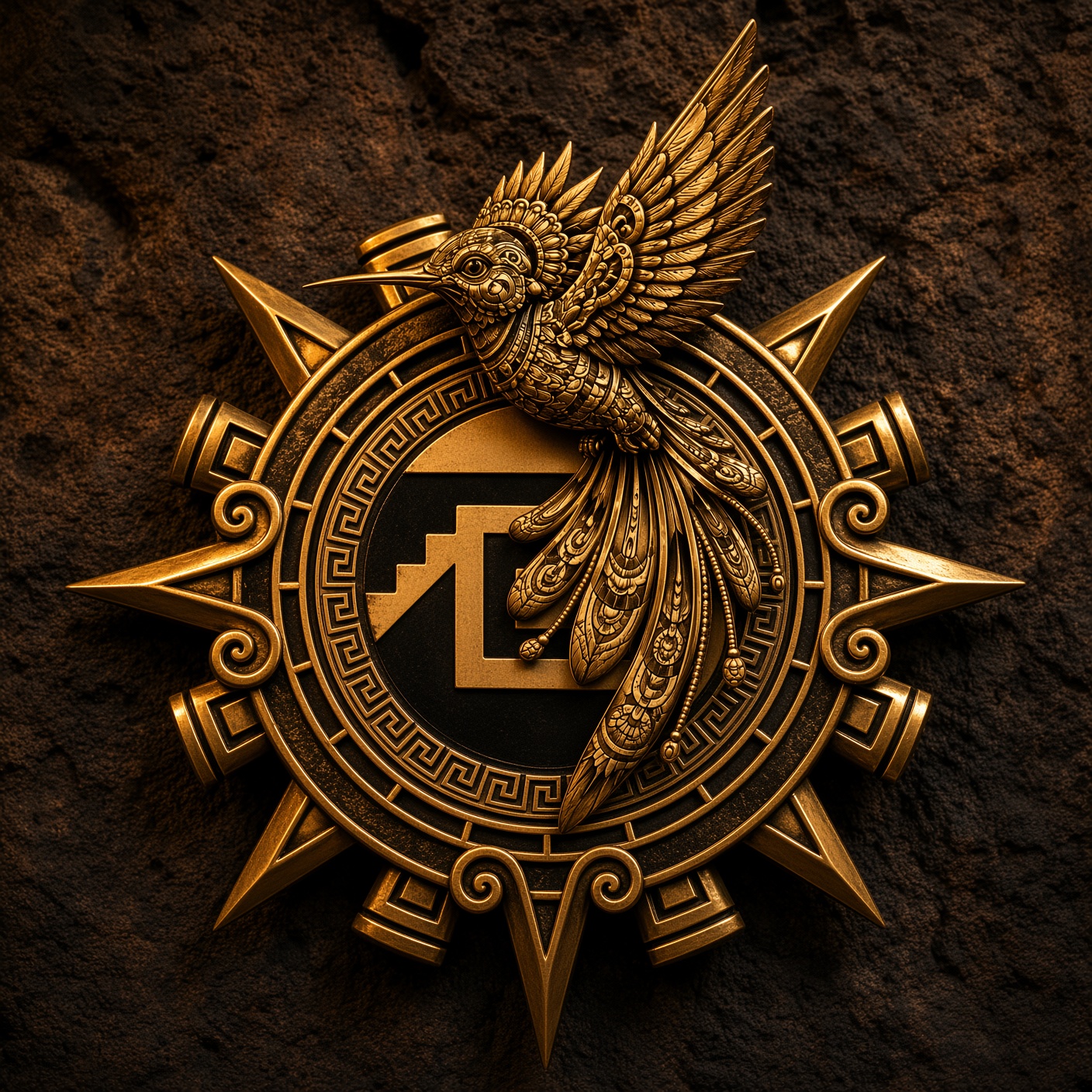
Hummingbird on the G of stairs
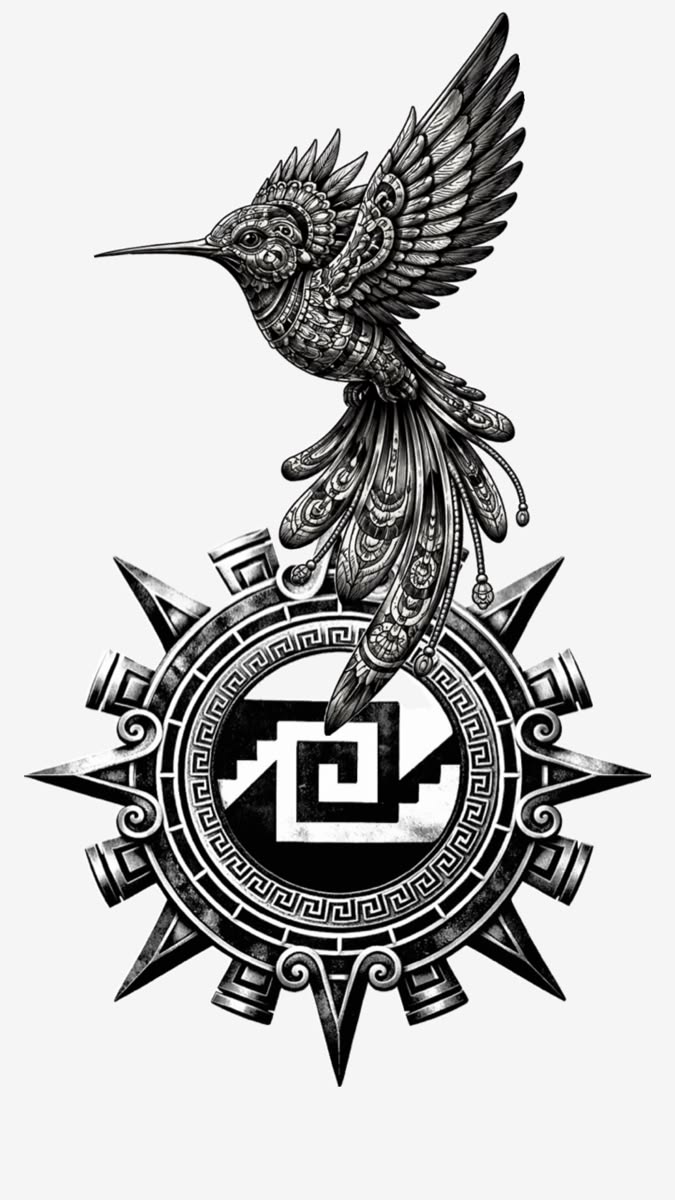
  • Hummingbird perched on a solar chimalli whose heart is the stepped G
  • The same sign as a round chimalli on a temple wall

This is the pairing the old books already knew, drawn as one picture: the patron bird sitting on the greca. The black-and-white stairs in the disc are xicalcoliuhqui — the twisted gourd. A thick band that turns at right angles like a temple staircase, then coils. The gap in the coil is why a modern eye reads a letter G.

Huitzillin is the hummingbird. Huitzilopochtli is that bird as a god — of the left, of the south. Fallen warriors escort the sun, then return as this bird, to drink from flower. Perching it on the G says: the one who never lands, standing on movement that has been stepped, like a pyramid turned into a shield.

The rayed rim is a solar chimalli. Daylight, Tonatiuh, the Fifth Sun. So the whole sign is three names at once — hummingbird, stairs, sun — which is how Mexica picture-writing likes to talk: not one word, a pair, a pile.


Yucatec Maya name · central Mexican design · hoo-NAHB koo

Hunab Ku

The one god — and the stepped spiral

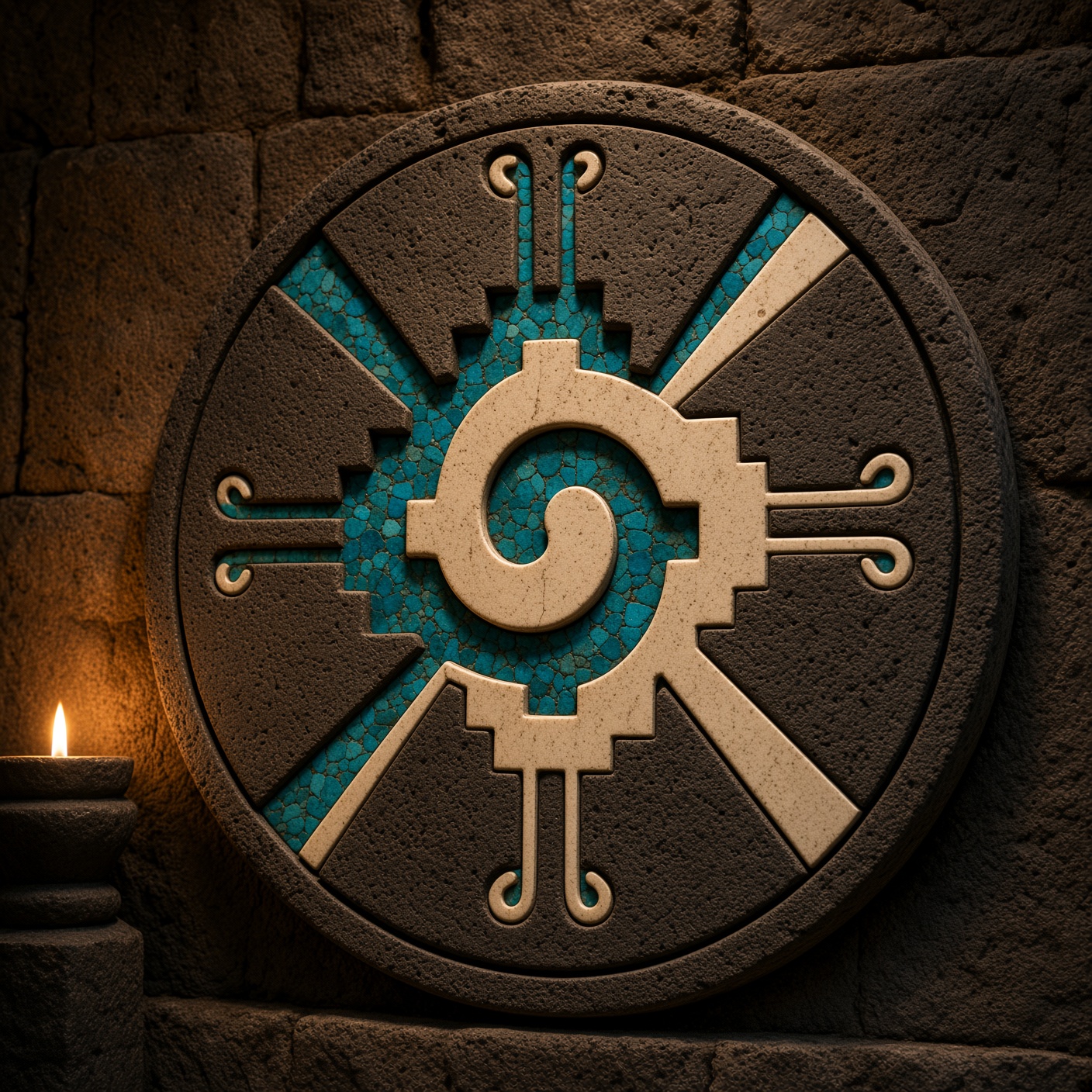
  • Hunab Ku emblem, black and white stepped spiral
  • Hunab Ku on a night field
  • The same emblem carved in volcanic stone with turquoise

Hunab Ku is Yucatec Maya: hunab, one, and k'uh / ku, god. In colonial dictionaries and the Books of Chilam Balam, Franciscans used it for the Christian God — 'the one god' — because they needed a Maya phrase that could carry a single creator. Pre-Hispanic Yucatán did not keep a temple under that name. Itzamná, K'inich Ajaw, Chaahk: those are the old faces.

The picture people now call Hunab Ku is another matter. A square of stairs, a spiral in the heart, rays with hooked ends. That geometry lives in central Mexican painting — kin to xicalcoliuhqui and to Ollin, movement. A close cousin appears in the 16th-century Codex Magliabechiano, an Aztec book, not a Classic Maya one. Stairs and a coil: the same family as the G on the chimalli.

In the late 20th century José Argüelles and others named this drawing Hunab Ku and 'galactic butterfly.' That naming is modern. The stairs are old. Living Yucatec speakers still say Hunab Ku for the one god in a Christian-Maya key. This hall keeps the two facts apart: the word is colonial Maya; the greca is highland; the butterfly-galaxy story is new. All three now walk together on skin and flags. That is also history.

Mexica · Mexico · KWAH-oot-lee NOCH-tlee

Cuāuhtli, nōchtli

Eagle on the nopal — the nation's sign

  • Eagle on the nopal, framed as a solar flower

Huitzilopochtli told the walkers they would stop when they saw an eagle on a nopal, on a stone in the water. That island became Mexico-Tenochtitlan. The cactus fruit — nōchtli — is drawn like a heart in the old books. The bird is the sun's.

The snake in the eagle's beak is later. The oldest pictures insist on bird and cactus. Colonial arms and the Mexican flag put the serpent there, and the whole country still wears that reading. The flower-sun around this pin is modern graphic. The center is the omen.

So the sign has layers, like a temple: Mexica founding, Spanish coat of arms, a republic's flag. None of those layers cancel the first. The eagle still lands where Mexi said it would.

Mexica · o-SEH-lohtl mee-KEES-tlee

Ocēlōtl, miquiztli

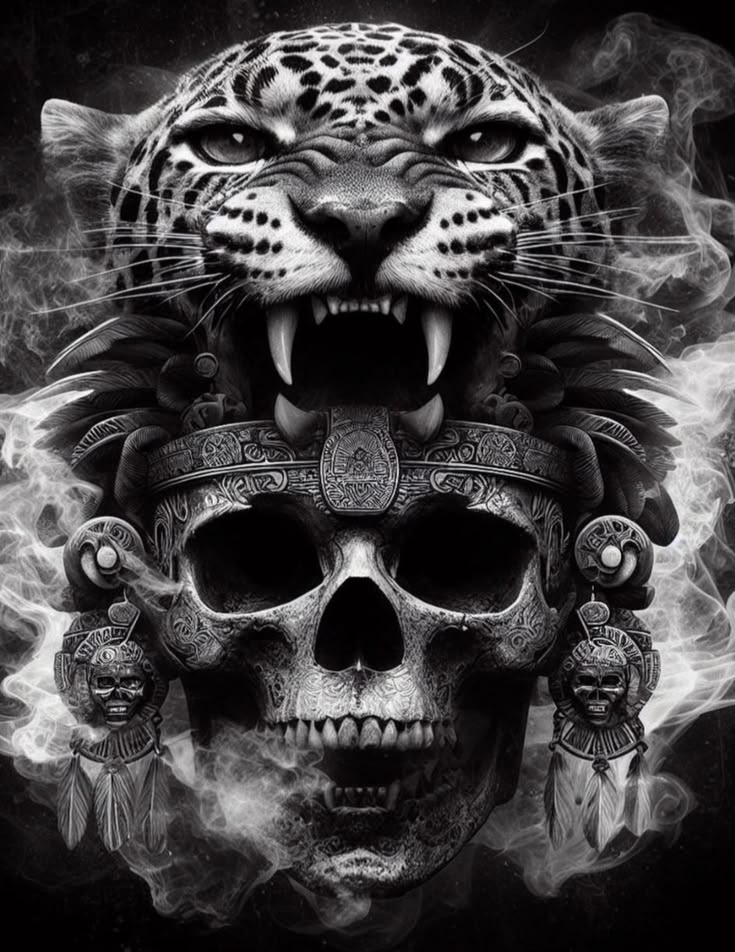
Jaguar over the death's head

  • Jaguar over a lord's skull with earflares and smoke

This is not one carved monument. It is how the two night-things still sit together in Chicano and Mexica art: the jaguar, and the skull. Ocēlōtl is Tezcatlipoca's nahualli — the animal-self of Smoking Mirror. The First Sun was Four Jaguar, and when that world ended the jaguars ate the people. Jaguar knights wore the whole pelt so the night had a face in the battle.

The skull is Mictlan's grammar. Mictlantecuhtli and Mictecacihuatl keep the bones. A lord's earflares on a death's head say: rank does not outrun the ninth level. Copal smoke is how a word reaches the dead. The jaguar's mouth open over the skull is not Hollywood. It is the First Sun remembering.

On a warrior, this pairing means the night order — cuāuhocēlōtl's dark half — and the knowledge that the sun's fire still ends in bone. Eagle by day. This by night.

Mexica and Maya, on living skin · mee-KEES-tlee teh-o-KAH-lee o-LEEN

Miquiztli, teōcalli, ollin

Death, the god-house, movement

  • Skull in a solar headdress, Hunab Ku on the brow, a pyramid at the jaw

A forearm as a teocalli. The skull is the person stripped to what Mictlan keeps. The headdress is solar — rays, jade-like plaques, the way a Mexica lord or a sun-priest is framed. On the brow sits the stepped spiral: the same greca as Hunab Ku and the G-chimalli. Movement, on the bone.

The pyramid under the jaw is Maya in silhouette — the Castillo at Chichén Itzá, Kukulkan's house, stairs you can count. Mexica temples were twin-stair, Huitzilopochtli and Tlaloc side by side. Tattoo does what empire also did: it stacks the valley and the peninsula in one body.

Tzompantli — the skull rack at the Templo Mayor — put death at the foot of the stairs on purpose. This ink does the same: you walk up, you walk down, the sun-sign sits on what remains. Not a costume skull. A theology you can wear.

Mexica · wee-tzeel-LEEN kwah-oo-shee-KAH-lee

Huitzillin, cuauhxicalli

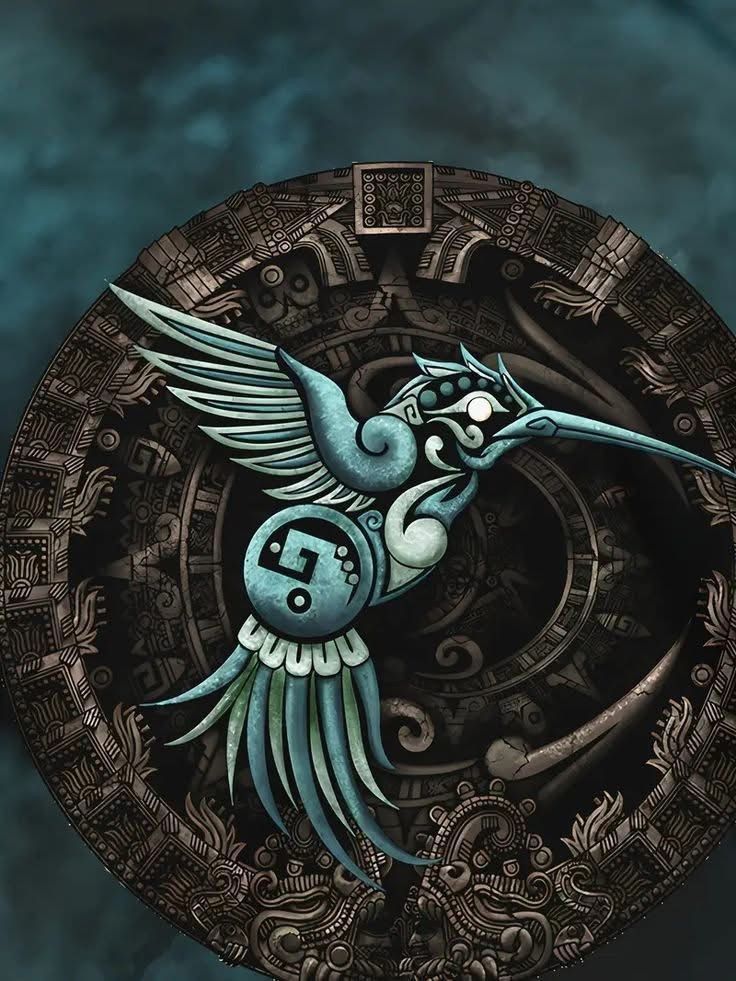
Hummingbird on the Sun Stone

  • Turquoise hummingbird over the carved Sun Stone

The disc behind the bird is the Piedra del Sol — the Sun Stone — Tonatiuh's face in the center, the four destroyed worlds around him, the Fifth Sun named Ollin. It is not a calendar you hang for the months. It is a statement: this age is movement, and it will end by earthquake.

The hummingbird in turquoise is Huitzilopochtli laid over that claim. Blue-green is precious stone, fire and year (xiuhitl), the color of the south and of the living bird. On the bird's body a small greca sits like a heart — stairs again, the G again, ollin again.

Read together: the sun that must be fed, and the bird that warriors become. The stone is Mexica of the island. The bird is Mexi. The little G on its chest is the same stairs as the chimalli. Three rooms of this hall, one picture.

The G of stairs is also among the warrior chimalli. The hummingbird's meaning is in the old ways.