In tlilli, in tlapalli

The books that survived

Screenfolds, tribute lists, a K'iche' telling in Latin letters. Maya, Mixteca-Puebla, Mexica. The pages below are the pages — public domain facsimiles, not paintings made for this hall.

Maya (Yucatán) · c. 11th–12th century (surviving copy of older tables)

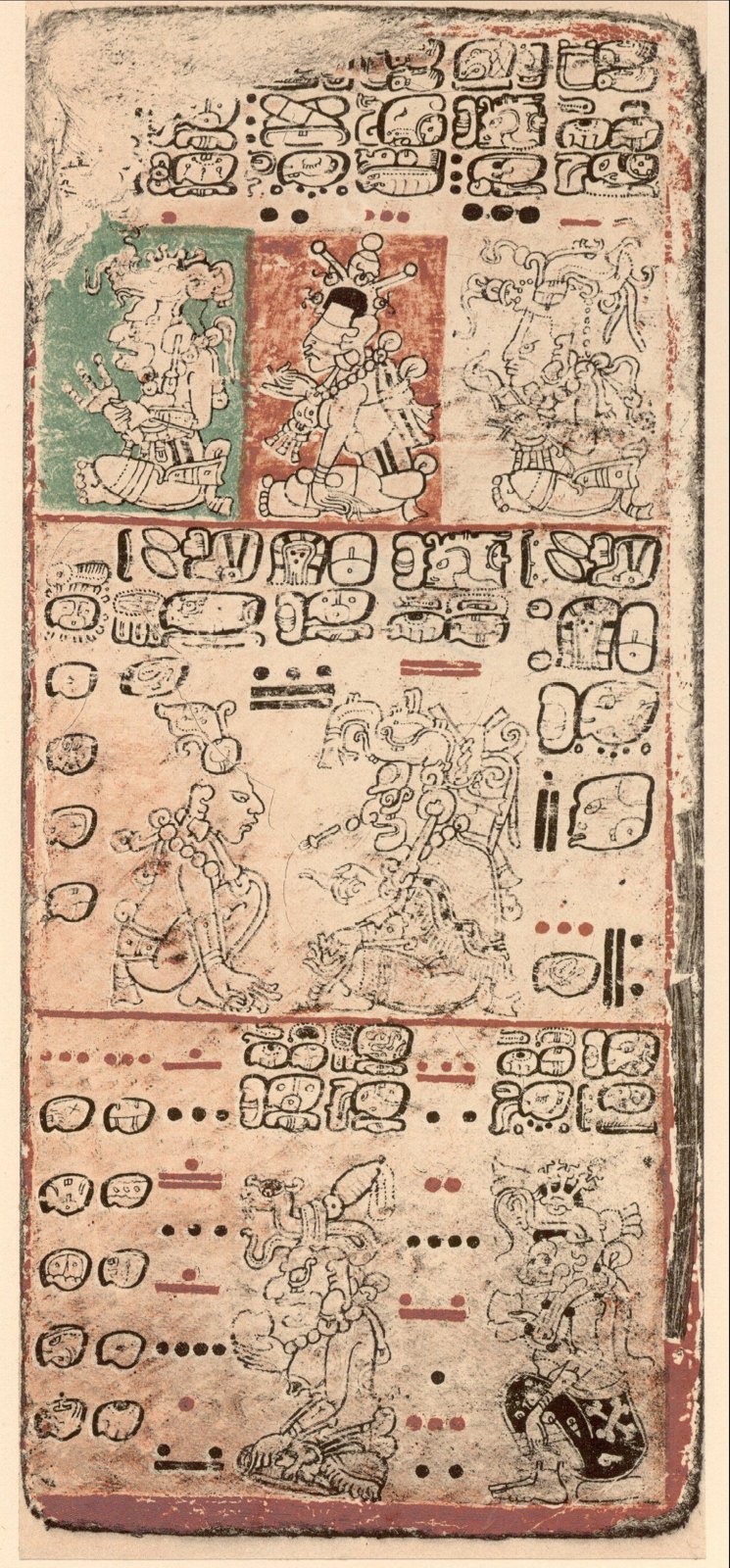
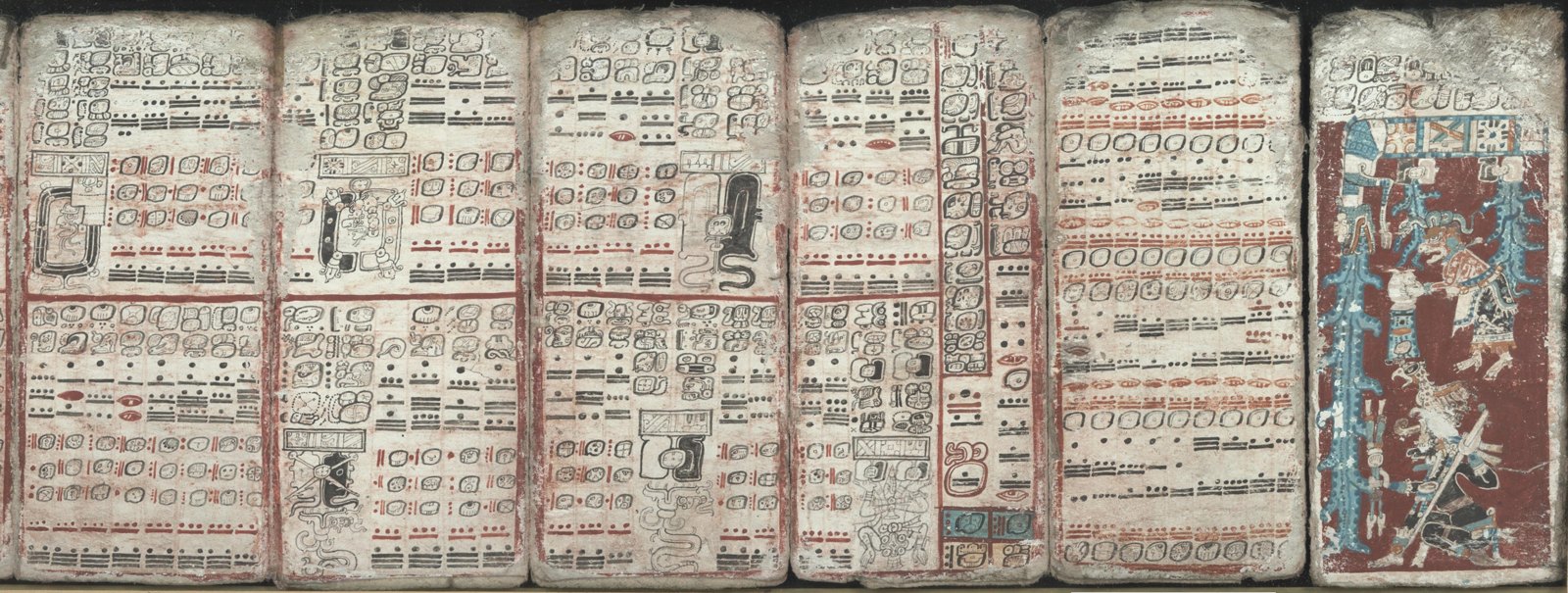
Dresden Codex

Sächsische Landesbibliothek, Dresden

Dresden Codex pages with eclipse tables and flood sceneDresden Codex — further page
  • One of four surviving Maya screenfold books (with Madrid, Paris, and the Grolier/Maya Codex of Mexico).
  • Bark paper, screenfold. Venus table of 584 days, eclipse table, 260-day tzolk'in almanacs, flood imagery.
  • Förstemann (1880) and later Thompson, Lounsbury, and Bricker established the astronomy. The 584-day Venus period is observational, not a metaphor.

Central Mexican (Puebla–Tlaxcala / Mixteca-Puebla style) · Late Postclassic, pre-Hispanic

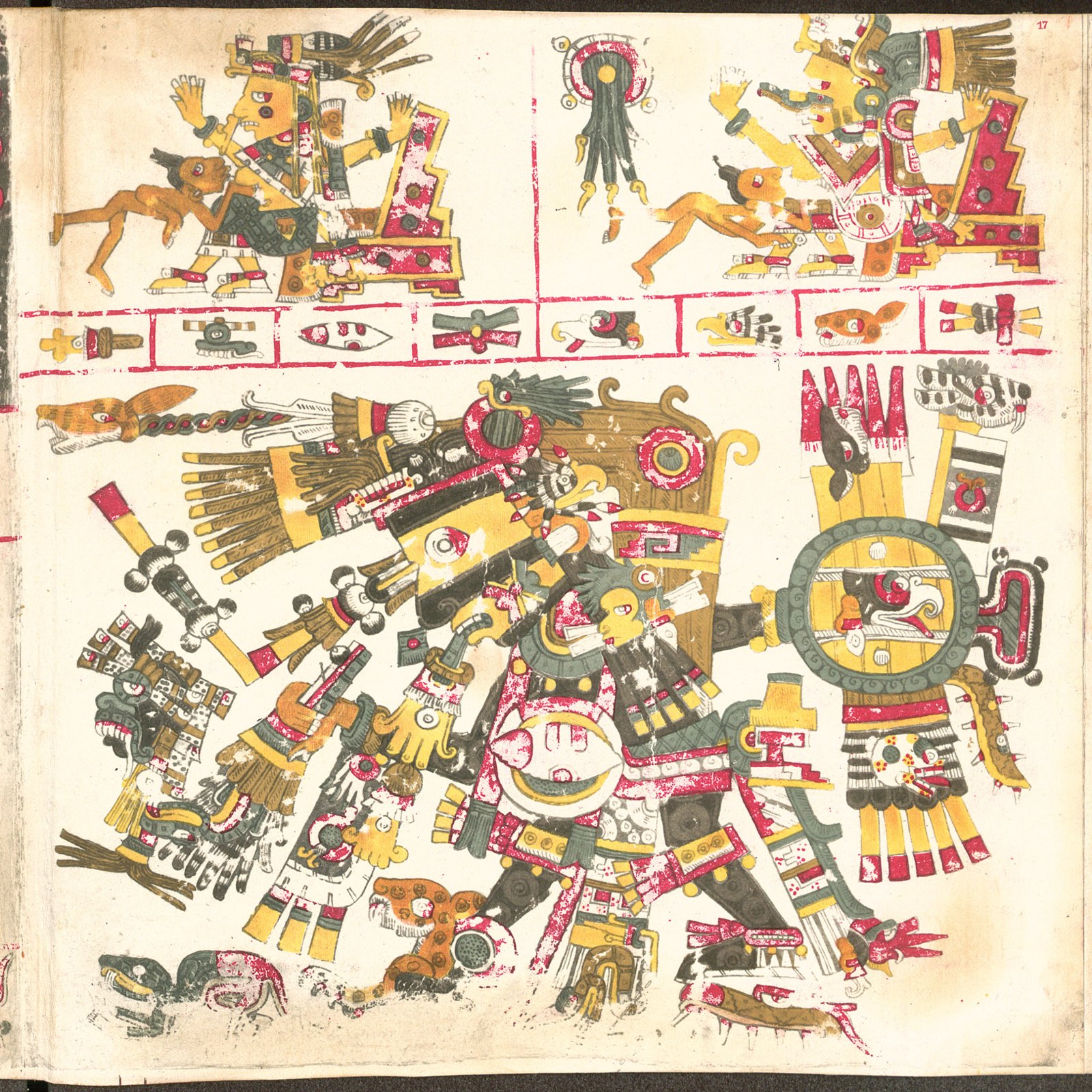
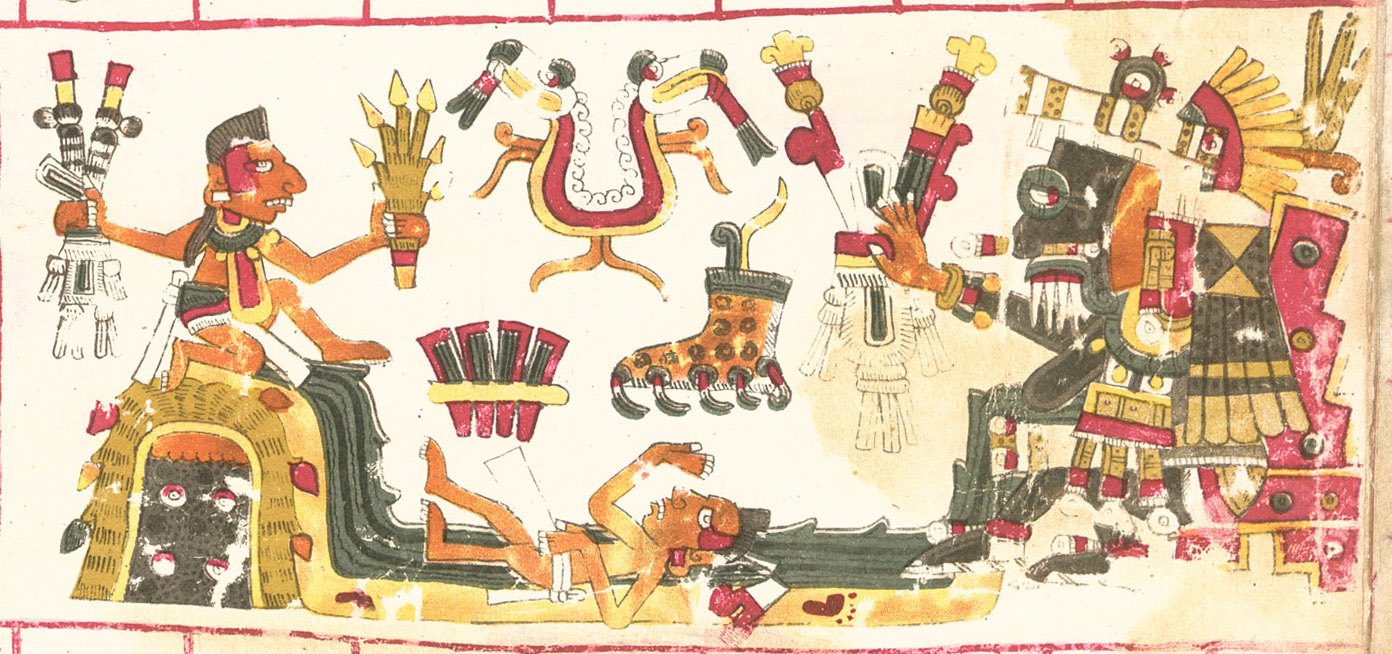
Codex Borgia

Vatican Library

Codex Borgia page 17, tonalpohualli paintingCodex Borgia — further page
  • A tonalamatl — a 260-day book of days, gods, and offerings — not a Mexica tribute list.
  • Painted before the Spanish war. Survived in Italy. The style is Mixteca-Puebla; the contents are the same day-count the Mexica used.
  • Page 17 (here) is the painted book as it is, not a reconstruction.

Mexica · Early 16th century

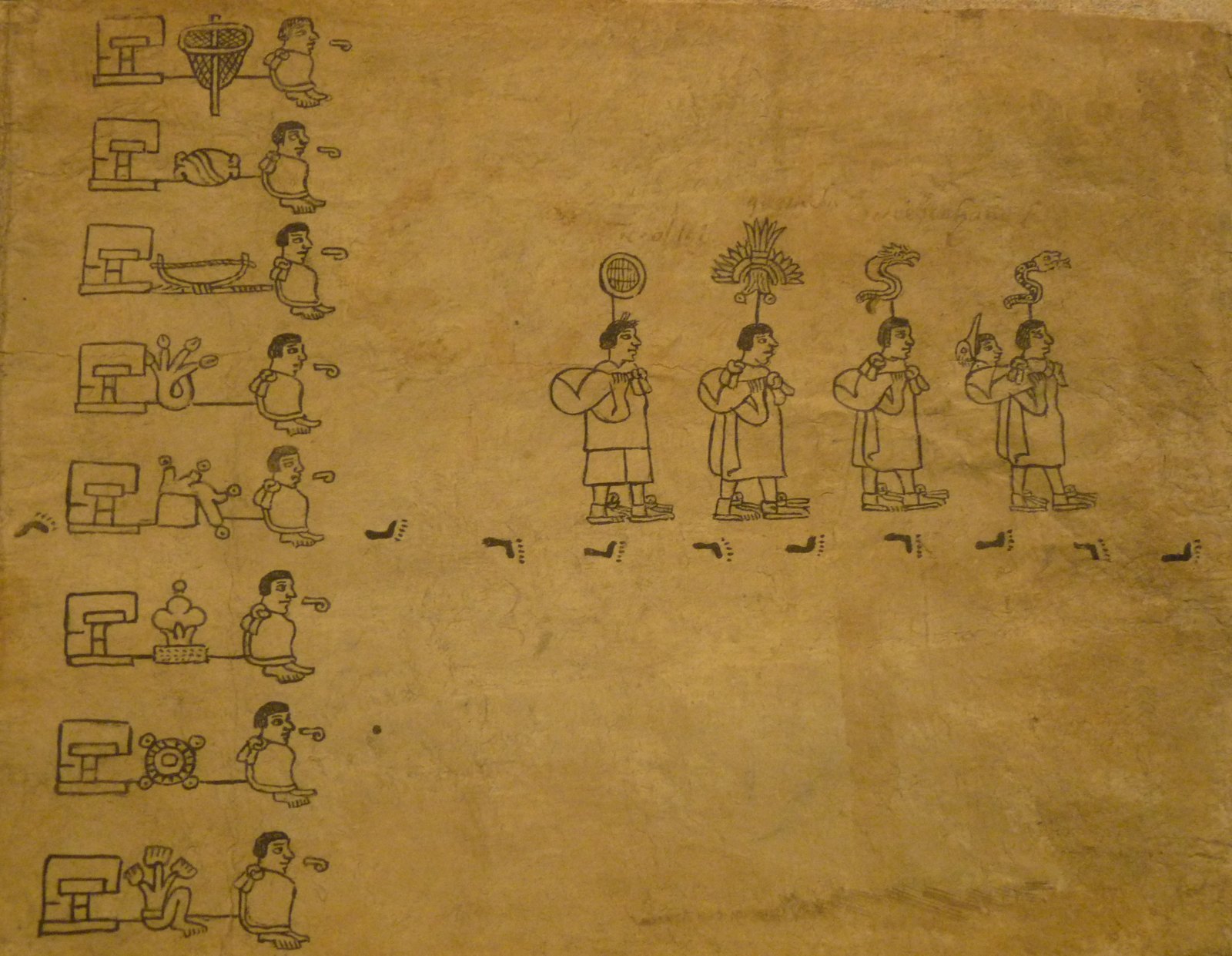
Codex Boturini (Tira de la Peregrinación)

Museo Nacional de Antropología, Mexico

Codex Boturini folio 2, the migration from Aztlan
  • The migration from Aztlan painted as a strip: footprints, year-signs, the sacred bundle, the four teomamaque in the larger story.
  • Post-conquest in materials, Mexica in the account. This is how the walk was written in pictures.

Mexica, painted for the Spanish viceroy · c. 1541

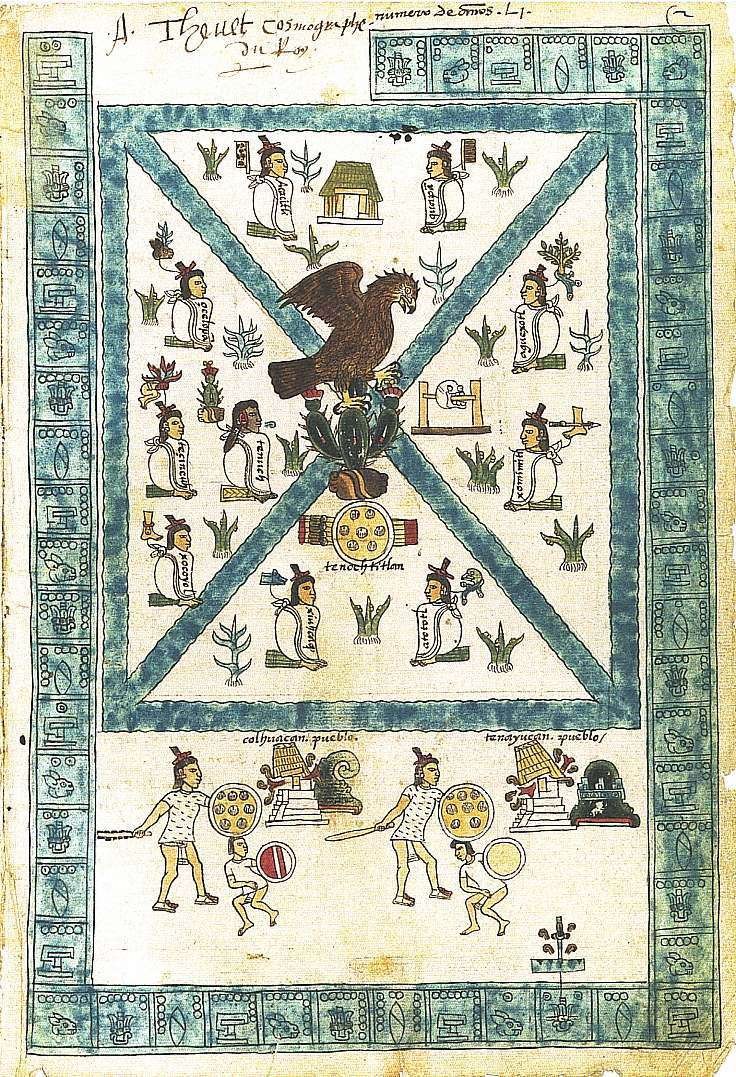
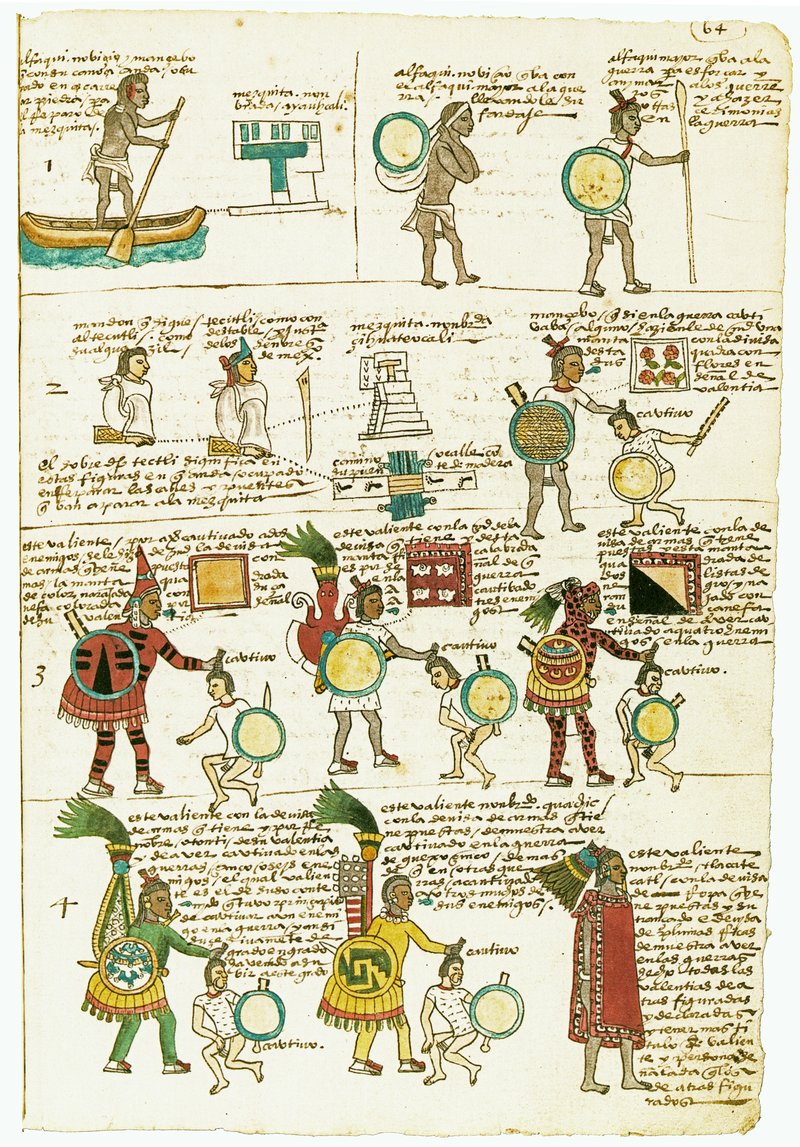
Codex Mendoza

Bodleian Library, Oxford

Codex Mendoza folio 2r, founding of TenochtitlanCodex Mendoza — further page
  • Three parts: the founding and conquests; the tribute of subject altepetl (chimalli among them); daily life and warrior ranks (fol. 64r).
  • Nahuatl-speaking painters, Spanish glosses. Public domain. Folio 2r is the eagle on the nopal in the lake — the omen as a city plan.

Maya

Count, Venus, maize

The 260-day count is shared highland knowledge. The Long Count and the Dresden tables are Maya writing. Dots, bars, and the shell zero are on the numbers page. Tonal reads today in the same 13 × 20.

  1. 01

    The tzolk'in is 260 days: 13 numbers × 20 day names. It is older than the Mexica tonalpohualli and structurally the same count. Classic Maya inscriptions run it alongside the haab' and the Long Count.

    Classic Maya inscriptions; Thompson; GMT correlation

  2. 02

    The haab' is 365 days: 18 uinals of 20 days plus 5 Wayeb' days. The Calendar Round (tzolk'in + haab') repeats every 52 haab' — the same 52-year bundle the Mexica used for the New Fire.

    Maya calendar arithmetic; Sahagún on the Mexica xiuhmolpilli

  3. 03

    Long Count: 1 kin = 1 day; 20 kin = 1 winal; 18 winal = 1 tun (360); 20 tun = 1 k'atun; 20 k'atun = 1 b'ak'tun. Era date 13.0.0.0.0 4 Ajaw 8 Kumk'u. Goodman–Martínez–Thompson correlation 584283 is the standard used here.

    GMT 584283; Martin & Skidmore 2012 discussion of 584286

  4. 04

    The Dresden Venus table uses 584 days (synodic period of Venus, ~583.92). Five Venus cycles = 8 haab' of 365. That is astronomy written in a book.

    Dresden Codex Venus table; Lounsbury

  5. 05

    Maya zero is written as a shell. Vigesimal (base-20) place notation with a zero is among the earliest in the world. Dots = 1, bars = 5.

    Classic period inscriptions; Dresden and Madrid Codices

  6. 06

    Hunab Ku is Yucatec for 'one god.' Colonial dictionaries and the Books of Chilam Balam use it for the Christian God. It is not a pre-Hispanic temple name. The stepped-spiral drawing sold as 'Hunab Ku' is a highland greca (kin to xicalcoliuhqui), popularized in the 20th century.

    Motul dictionary; Chilam Balam; Magliabechiano greca; Argüelles (modern naming)
K'iche' Maya · Oral tradition; written in the 1550s; copied by Francisco Ximénez c. 1701

Popol Vuh

Newberry Library, Chicago (Ximénez manuscript)

  • Heart of Sky (Huracán and his faces) and the Plumed Serpent (Q'uq'umatz) speak the world. Animals cannot praise, so people are tried: mud, then wood, then maize.
  • The Hero Twins, Hunahpu and Xbalanque, defeat Seven Macaw and the lords of Xibalba. They become the sun and the moon.
  • This is K'iche', not Yucatec and not Mexica. The maize people and the twins are highland Maya scripture, written in Latin letters after the war, from an older telling.

Nahuatl

The language is not a ruin

Greetings, names, and paired speech live in Words. Elder-speech is among the Ways.

  1. 01

    Nahuatl is a Uto-Aztecan language. Classical Nahuatl is the prestige form of the 16th-century altepetl; millions still speak modern Nahua varieties in Mexico.

    Ethnologue; Launey; Karttunen

  2. 02

    A difrasismo is two nouns that make a third meaning: in xōchitl in cuīcatl (flower and song = art); in mitl in chimalli (arrow and shield = war); in ixtli in yōllōtl (face and heart = a whole person); in tlilli in tlapalli (black ink and red ink = writing).

    Sahagún; Garibay; Bright

  3. 03

    Huehuetlahtōlli is elder-speech: how a person was spoken into being in the calmecac and the house. Recorded at length in Florentine Codex Book 6.

    Sahagún, Book 6

  4. 04

    Mexica (Mēxihcah) is the name taken from Mexi / Mexitli, a form of Huitzilopochtli, on the road from Aztlan. Azteca names the people of Aztlan before that renaming. The Spanish used 'Aztec' later, broadly.

    Durán; Tezozomoc; Codex Boturini tradition

Sources

  • Dresden Codex — SLUB Dresden; Förstemann 1880 facsimile (public domain).
  • Codex Borgia — Vatican; 1898 Loubat/FAMSI facsimile (public domain).
  • Codex Boturini — INAH / Museo Nacional de Antropología.
  • Codex Mendoza — Bodleian Library, Oxford, c. 1541 (public domain).
  • Popol Vuh — Ximénez manuscript, Newberry Library; Tedlock translation for English reference.
  • Sahagún, Florentine Codex, Book 6 (huehuetlahtōlli).