Mexico-Tenochtitlan
The nopal on the stone
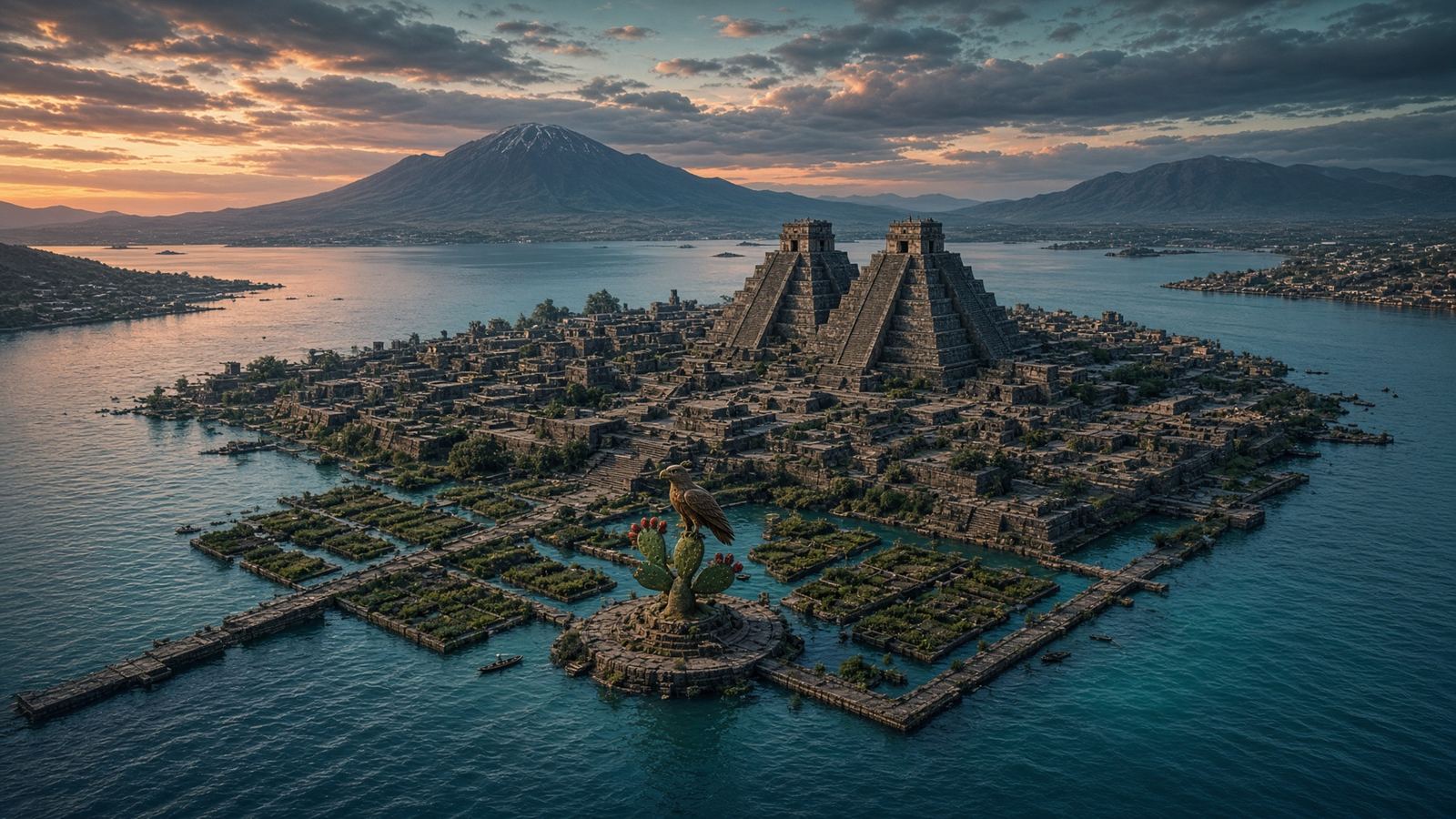
The Mexica walked from Aztlan until Huitzilopochtli showed them an eagle on a cactus in the lake. That island became the altepetl that ate the valley — and still names the country. The walk itself is on the origin road.
Huēyi Teōcalli
Templo Mayor
A twin pyramid at the lake's navel. The south stair climbed to Huitzilopochtli; the north to Tlaloc. War and rain, side by side, so the Fifth Sun and the maize would both be fed. The Coyolxauhqui Stone lay at the foot of the war god's stairs — the sister thrown down the mountain, in basalt.
Cuāuhtli, nōchtli
The sign in the lake
Huitzilopochtli told the Mexica to stop when they saw an eagle on a nopal, on a rock in the water. That island became Mexico-Tenochtitlan. The cactus fruit (nōchtli) and the eagle still sit on the Mexican flag. The snake in later pictures is a colonial gloss; the oldest books insist on the bird and the cactus.
Chināmitl
Chinampas
Garden-islands staked in the shallow lake: mud, reeds, and willow roots. They fed a city of hundreds of thousands. The Spanish called Tenochtitlan a Venice. The Mexica called it the place where the nopal stands on stone.
Tlāltelōlco
Tlatelolco
The sister city on the north of the island, and the great market. Sahagún's informants said you could find everything there — jade, cacao, songbirds, obsidian. Empire was a market as much as a temple.
Nauhcampa
Four quarters
Color and direction are not decoration. They are how the world was folded. Center is fire — Xiuhtecuhtli — where the four roads meet.
Tlapcopa
East · Red
The sun's house. Birth, blood, the day's first heat.
Mictlampa
North · Black
The dead's quarter. Dry season, obsidian, Tezcatlipoca's night.
Cihuatlampa
West · White
The women's side, where the sun falls. Evening, bones, the moon's road.
Huitztlampa
South · Blue
The thorn-side, the hummingbird's left. Huitzilopochtli's own direction.
Xiuhpōhualli
Eighteen feasts
The solar count is 18 twenties plus five nameless days (nemontemi). Order follows Sahagún's Book 2. This is the year's spine, not a reconstruction of a single 1521 date — year-bearer correlations still argue.
01
Atlcahualo
Ceasing of the water
Tlaloc
The year opens asking for rain. Also called Cuauhuitlehua — the raising of trees.
02
Tlacaxipehualiztli
Flaying of men
Xipe Totec
Spring's hard feast. New skin for the year. Goldsmiths' god at the center.
03
Tozoztontli
Little vigil
Coatlicue, Tlaloc
First watch of the growing season. Flowers and the earth mother.
04
Huey Tozoztli
Great vigil
Centeotl
Maize god's watch. The young plant is treated as a person.
05
Toxcatl
Dry thing
Tezcatlipoca
The smoking-mirror's own month. A young man lived as the god for a year, then the feast ended him.
06
Etzalcualiztli
Eating of maize-and-bean
Tlaloc, Chalchiuhtlicue
A meal of etzalli. Water gods fed so the canals would not fail.
07
Tecuilhuitontli
Little feast of lords
Huixtocihuatl
Salt goddess. A smaller nobles' feast before the great one.
08
Huey Tecuilhuitl
Great feast of lords
Xilonen
Tender maize. The lords' table and the green ear of corn.
09
Tlaxochimaco
Giving of flowers
Huitzilopochtli
Also Miccailhuitontli, the little feast of the dead. Flowers for the sun and the ancestors.
10
Xocotl Huetzi
The fruit falls
Xiuhtecuhtli
A pole, a falling fruit, the old fire. Great feast of the dead in some counts.
11
Ochpaniztli
Sweeping of the roads
Toci / Teteoinnan
Grandmother of the gods. The city swept clean before the war season.
12
Teotleco
Arrival of the gods
All the teteo
The gods come back. Footprints in flour marked who had returned.
13
Tepeilhuitl
Feast of the mountains
Mountain gods
Dough figures of peaks. Tlaloc's high country, remembered in the city.
14
Quecholli
Precious feather
Mixcoatl
Cloud-serpent, hunt god. Arrows made, game taken, the dry fields armed.
15
Panquetzaliztli
Raising of banners
Huitzilopochtli
The patron's own month. Paper banners, the south stair, the hummingbird's war.
16
Atemoztli
Descent of water
Tlaloc
Rain coming down the mountains into the lake. The year leaning toward wet.
17
Tititl
Stretching
Ilamatecuhtli
Old woman of the year. Stretching the last of the cycle.
18
Izcalli
Growth / rebirth
Xiuhtecuhtli
Fire drilled again. Children lifted by the head so they would grow. Then five nameless days.
+5
Nemontemi
Nameless days
Five leftover days at the year's edge. Unlucky, unworked, waited out until Izcalli's fire could be trusted again.
The daylight and night faces of Mexica war are the eagle and jaguar knights. The name began with Mexi, on the road from Aztlan.